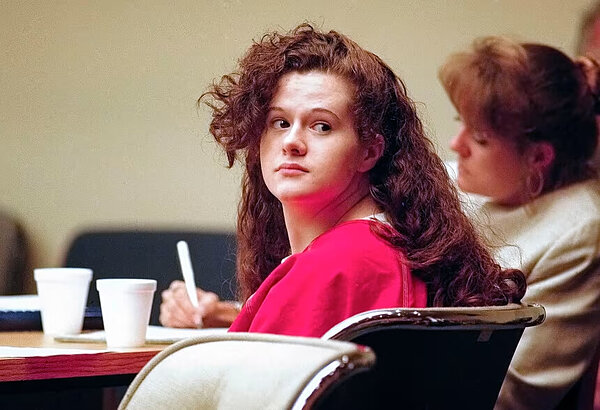
tag:exoneration.nd.edu,2005:/news-and-media/newstag:exoneration.nd.edu,2005:/latestExoneration Justice Clinic | News2026-10-01T12:48:00-04:00Notre Dame Law School Exoneration Justice Clinictag:exoneration.nd.edu,2005:News/1859172026-10-01T12:48:00-04:002026-10-01T12:48:49-04:00Notre Dame Exoneration Justice Clinic statement in opposition to the death penalty and execution of Christa PikeChrista Pike seen at a hearing for a new trial on January 12, 2001 (Knoxville News Sentinel/USA Today Network/Imagn Images)
The Notre Dame Exoneration Justice Clinic (EJC) strongly condemns Tennessee’s attempted execution of Christa Pike. The tenants of Christianity, and Catholic doctrine specifically, recognize the dignity and sanctity of human life without exception. The death penalty violates that fundamental principle. As Pope Francis has proclaimed, “Capital punishment offers no justice to victims, but rather encourages revenge. And it prevents any possibility of undoing a possible miscarriage of justice.” The Catholic Church teaches, in the light of the Gospel, that “the death penalty is inadmissible because it is an attack on the inviolability and dignity of the person[.]” All Catholics should therefore oppose and condemn the death penalty. It is the EJC’s sincere hope that all states swiftly abandon the use of such a cruel, barbaric, medieval, and irrevocable method of punishment.
]]>
Notre Dame Law Schooltag:exoneration.nd.edu,2005:News/1859142026-10-01T08:41:00-04:002026-10-01T08:41:09-04:00Notre Dame Exoneration Justice Clinic continues annual summer internship program with students from Notre Dame, St. Olaf College, Kenya, and MexicoA group of EJC summer interns at the Notre Dame Exoneration Justice Clinic
This summer, the Notre Dame Exoneration Justice Clinic (EJC) welcomed a diverse cohort of 14 student interns from the University of Notre Dame, St. Olaf College, Strathmore Law School in Nairobi, Kenya, and the National Autonomous University of Mexico (UNAM) in Mexico City, Mexico. The interns worked primarily on intake cases, allowing them to review several requests for legal representation and make recommendations on whether to accept or reject cases based on a rigorous screening process. In addition, the interns were assigned to assist in ongoing EJC cases, providing them with a comprehensive understanding of the overall process of building a case.
This summer’s cohort of EJC interns included third-year Notre Dame Law School student Zoë Bonnichsen and second-year law students, Aaron Qiao, Maggie Feighery, and Jack Puricelli; undergraduate Notre Dame students, Victor Kaminski, Caroline Petrikas, and Marco Gonzalez; undergraduate St. Olaf College students, Alex Hollie, Emma Linder, and Sarah Degand; Strathmore Law School exchange students, Anisa Ali and Gina Mulaku, from Nairobi, Kenya; and UNAM exchange students, Diana Bolaños Cuevas and Griselda Santos Garnica, from Mexico City, Mexico.
“Our obligation to our clients does not end at the end of the academic year. We have an obligation to our clients every month of the year,” said Professor Jimmy Gurulé, founder and director of Notre Dame Law School’s Exoneration Justice Clinic. He added that the annual summer internship program provides "intensified participation for the students.”
Each year, the program includes Notre Dame Law students who continue their involvement in the EJC during the academic year.
2L Maggie Feighery speaks during the EJC welcome picnic for summer interns
One of those students, 2L Maggie Feighery, reflected on the hands-on experience the summer program provides. “The EJC is unique in that we get outside of the classroom setting of hypotheticals and distant case studies and we are working with real clients whose lives are affected by the work we’re doing in this office every day,” said Feighery.
This summer's cohort also included students from Strathmore Law School in Kenya and UNAM in Mexico. "This is an opportunity for the EJC to train foreign students,” said Gurulé. “We are taking our experience and we're sharing it with foreign students. The hope would be that they take the education they receive and enhance their efforts back at their home site."
Gina Mulaku, one of the two exchange students from Strathmore Law School who participated in the program, reflected on the practical experience she gained through the EJC. “The activities that we take part in at the Exoneration Justice Clinic at Notre Dame Law School are very practical, and so I’m able to learn and see how investigations are carried out and how a real setting trial is done in the American law system,” said Mulaku. “I believe this will help me further my law studies in that now, I’m able to make a good decision on what I want to do in the future.”
Mulaku added, “Also, I am learning a lot about what it means to be an ethical lawyer, or what it means to do proper investigations in a case, what it means to follow the law and, at the end, always promote access to justice to everyone. I believe that that will enable me to be a great lawyer in the future.”
EJC summer interns who worked on cases for the Program for the Defense of Mexican Nationals (PDM)
Griselda Carina Santos Garnica, one of the two exchange students from UNAM who participated in the program, said, “The difference is that in the classroom we learn all of the theoretical and written aspects, while in the clinic, we have the opportunity to put all of that knowledge into practice. I believe it is a wonderful way to contribute and to help people who need our assistance.”
The UNAM students worked on cases involving Mexican nationals wrongfully convicted of a crime they did not commit. Their work was conducted through the Program for the Defense of Mexican Nationals (PDM), a dimension of the EJC that provides legal assistance to Mexican nationals facing criminal charges or wrongful convictions.
The interns gained hands-on experience throughout the summer through their work on a variety of EJC cases and projects.
The main responsibility of the interns was to assist the clinic in deciding which cases to accept for legal representation, primarily by reviewing requests that the EJC received from Indiana prison inmates. The interns evaluated the inmates’ claims of innocence to determine their credibility. They assessed whether or not the EJC could prove the inmates’ actual innocence and explored potential avenues that the clinic could pursue to prove their innocence. To conduct their preliminary evaluations, the interns used a comprehensive intake process, developed by the EJC, that is guided by about a dozen objective factors and criteria. After conducting their evaluations, the interns reviewed correspondence, a detailed questionnaire from each inmate, and trial transcripts to look for evidence of wrongful conviction.
Strathmore Law School exchange student Anisa Ali speaks during the EJC welcome picnic for summer interns alongside fellow Strathmore exchange student Gina Mulaku
The interns then prepared detailed recommendation memos for Gurulé and the clinic’s attorneys to review, allowing them to enhance their legal writing skills. The clinic also held intake meetings, where the interns delivered an oral presentation to defend their recommendation.
In addition, the students attended a lunch seminar with Rachel Schneider '23 J.D., a former EJC alum who is now a prosecutor. They also met with EJC client Iris Seabolt, attended a murder trial in St. Joseph County court, and made prison visits to meet with clients. The students who worked on PDM cases got to visit the Mexican consulate in Chicago, as well.
The Notre Dame Exoneration Justice Clinic has received approximately 850 requests for legal representation since its opening in the fall of 2020. The EJC accepts around 3 percent of requests. Currently, the clinic is actively engaged in approximately 17 cases.
Learn more about Notre Dame Exoneration Justice Clinic at exoneration.nd.edu.
EJC interns reflect on their experiences during the summer program
Interns reflected on their experiences working with the EJC and what they learned from the clinic's hands-on approach to legal education.
Aaron Qiao
2L at Notre Dame Law School and Notre Dame Exoneration Justice Clinic Student
“What I would like to tell a prospective student about the EJC summer program is that if you want your mission in the legal field to be about justice and about doing right, and if you are interested in the criminal field, this is one of the best opportunities to do for your first summer, just because you have a very well-guided understanding by the faculty and the staff here to get a full, comprehensive understanding of the criminal legal system.”
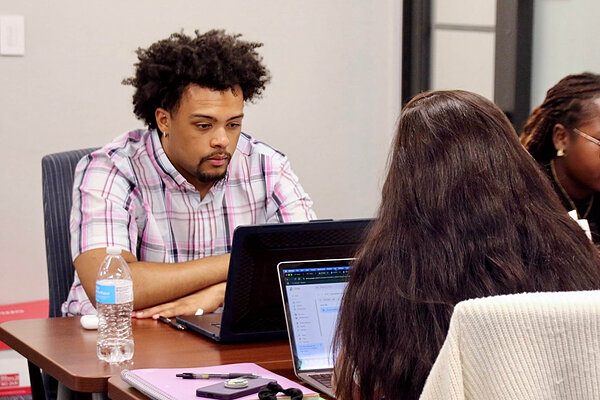
St. Olaf College undergraduate student Alex Hollie works alongside fellow EJC summer interns
Alex Hollie
St. Olaf College Undergraduate Student
“This experience is different from a traditional classroom setting because we’re directly involved in people’s lives and if they’ll be able to retain post-conviction relief.”
Caroline Petrikas
University of Notre Dame Undergraduate Student
“Participating in the EJC summer internship is exposing me to a new area and helping me move beyond just the theoretical in classrooms to the actual, tangible challenges in our political system. As a Political Science major, I think we often talk about a lot of the discriminatory or prejudice issues with the system, but I think it’s much different to learn about those than it is to actually see how they’re being addressed in cases and the challenges that everybody is facing. This experience is helping me understand them beyond the classroom in a more physical sense.”
“I just want to thank Professor Steven Landis in the Political Science department and Professor Gurulé for all of their work in setting up this partnership and for extending the opportunity to me. I am very grateful for this opportunity. I want to thank Professor Gurulé, as without his leadership and guidance, the clinic would not be here today.”
UNAM exchange students Diana Estefanía Bolaños Cuevas and Griselda Carina Santos Garnica work on cases through the PDM
Diana Estefanía Bolaños Cuevas
National Autonomous University of Mexico (UNAM) Exchange Student
“First, I would like to thank Professor Jimmy Gurulé for this experience, and also Dr. Imer Flores from UNAM for trusting us with this project. It is a great initiative for both universities. I would also like to thank my family for their support and for helping me achieve yet another meaningful experience.”
“I believe the experience in the EJC will help me tremendously, not only professionally but also personally and academically, since I am able to compare different legal systems and interact with many peers who share similar professional aspirations.”
Griselda Carina Santos Garnica
National Autonomous University of Mexico (UNAM) Exchange Student
“I would like to thank UNAM for creating these partnerships with other universities. I believe they are greatly needed, at least in our country. At Notre Dame, I would like to thank Professor Jimmy Gurulé for choosing UNAM and, in this case, for selecting me to be part of this project. I would also like to thank Joshua Kuiper. He has truly been a tremendous help. At Notre Dame, he is always very attentive to us as exchange students. They have helped us tremendously throughout this entire clinical experience.”
2L Jack Puricelli and Notre Dame undergraduate student Marco Gonzalez work alongside one another during the EJC summer internship program
Jack Puricelli
2L at Notre Dame Law School and Notre Dame Exoneration Justice Clinic Student
“I’m a Catholic. I’m a Christian. I strongly believe that the law should be a tool of mercy. I came to law school because I knew law was a vocation for me, so working in the EJC summer internship program furthers that goal of learning how to use the law as a tool of justice and a tool of mercy.”
Marco Gonzalez
University of Notre Dame Undergraduate Student
“The EJC summer internship program is going to prepare me for a future in law because I’m doing a lot of intake work, reading through a lot of cases, and going through a lot of different aspects of the law that are really helping me understand the criminal justice system. I would tell a prospective EJC student that this work is awesome because it’s fulfilling and interesting, you learn a lot, and you actually get to help real people along the way.”
Originally published by Arienne Calingo at law.nd.edu on October 01, 2026.
]]>
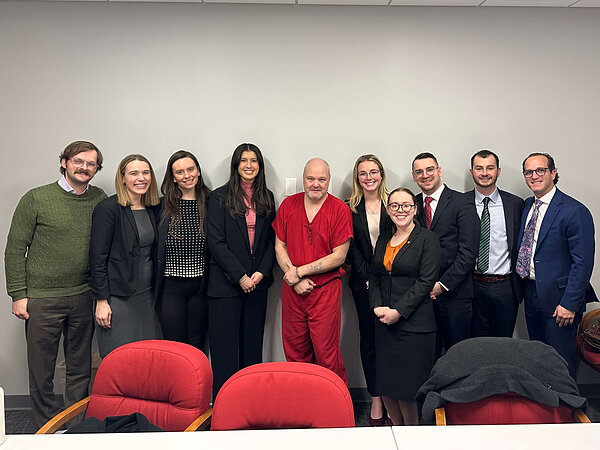
Arienne Calingotag:exoneration.nd.edu,2005:News/1856312026-09-18T13:49:00-04:002026-09-21T09:31:27-04:00Indiana Court of Appeals Affirms New Trial for Notre Dame Exoneration Justice Clinic Client Jason HubbellMembers of the EJC team, from left to right: Eric Wahoff '25 J.D., Megan Sarsfield '25 J.D., Alex Ragland '26 J.D., 2L Katherine Mojica, Jason Hubbell, Autumn Chassie '26 J.D., EJC staff attorney Lenora Popken, Adam Miller '25 J.D., EJC staff attorney Kevin Murphy, and adjunct professor of law Elliot Slosar
The Indiana Court of Appeals has affirmed a lower court ruling granting Jason Hubbell a new trial, a client of the Notre Dame Exoneration Justice Clinic (EJC) who has spent more than 28 years in prison for the 1997 murder of Sharon Myers.
In a September 1 published opinion, the Court of Appeals affirmed Bartholomew County Circuit Court Judge Kelly S. Benjamin’s ruling that the State of Indiana violated Hubbell’s constitutional rights by withholding material exculpatory evidence from his defense. The appellate court explained that the case against Hubbell at his 1999 trial was “not strong” and that the suppressed evidence undermined confidence in Hubbell’s conviction.
“This is a major victory. Jason has been in prison well over 25 years,” said Professor Jimmy Gurulé, faculty director of the Notre Dame Exoneration Justice Clinic. “The critical evidence that the State withheld was evidence that pointed to the actual killer of Sharon Myers. Had that evidence been presented to the jury at trial, Jason wouldn’t have been convicted. What happened to Jason is a tragic miscarriage of justice.”
Hubbell was convicted in 1999 of the 1997 abduction and murder of Myers in Columbus, Indiana, and sentenced to 75 years in prison. The EJC began representing Hubbell on a pro bono basis in October 2022.
In September 2025, Benjamin vacated Hubbell’s conviction and granted him a new trial after finding that the State had violated his constitutional rights under Brady v. Maryland by withholding material exculpatory evidence. The State subsequently appealed the decision.
The withheld evidence implicated Michael Dean Overstreet, who was convicted of the 1997 abduction, rape, and murder of Kelly Eckart and sentenced to death. The murders of Myers and Eckart shared significant similarities. Both women were strangled with ligatures made from their own clothing, and the women were killed within two miles of each other in the Atterbury Wildlife Preserve.
Among the undisclosed evidence were statements from Overstreet’s then-wife that, on the day Myers disappeared, Overstreet left home unusually early in a white cargo van and returned later that evening disheveled and covered in blood. The court also discussed statements from a former co-worker who told investigators that Overstreet had said he was having an affair with a woman named Sharon in Columbus and had gotten her pregnant.
During a five-day evidentiary hearing in February 2025, EJC attorneys and students presented evidence concerning Overstreet’s involvement in Myers’s murder. Hubbell’s original trial counsel testified that, had the undisclosed evidence been available before Hubbell’s trial, he would have investigated Overstreet and presented him to the jury as an alternate suspect.
In its opinion, the Court of Appeals concluded that the evidence withheld by the State was material and exculpatory. The court noted that eyewitnesses described a blond man with Myers shortly before her disappearance, while Hubbell has brown hair. The evidence implicating Overstreet was consistent with a white cargo van seen by eyewitnesses, and pubic hairs near Myers’s body did not match Hubbell.
“As a result of the State’s suppression of the exculpatory evidence, we must conclude that our confidence in Hubbell’s conviction has been undermined,” the appellate court wrote.
Judge Paul Mathias authored the majority opinion, with Judge Mary DeBoer concurring. Judge Dana Kenworthy concurred in the result in a separate opinion, agreeing that the State failed to disclose exculpatory evidence, that the evidence was material, and that Hubbell should receive a new trial.
EJC staff attorney and term teaching professor Kevin Murphy ’14 J.D. led the investigation and litigation of Hubbell’s case, with critical assistance from EJC legal assistant Anne Peterson ’93, ’02 J.D.; EJC staff attorney Lenora Popken ’20 J.D.; adjunct professor of law Elliot Slosar; and EJC investigator Christian Sheckler. Alex Ragland ‘26 J.D., Autumn Chassie ‘26 J.D., third-year law student Ella Cain, second-year law student Aaron Qiao, and Notre Dame undergraduate student Victor Kaminski all assisted with preparing the briefing on appeal.
Sarah P. Hogarth ’15 J.D. and other attorneys at McDermott Will & Schulte provided invaluable assistance to the EJC with the appeal. The Court of Appeals opinion lists Gurulé, Murphy, Popken, and Hogarth as attorneys for Hubbell.
Since its founding, the EJC has remained committed to criminal justice reform, litigating wrongful conviction cases, and educating the public about miscarriages of justice.
Learn more about the Notre Dame Exoneration Justice Clinic at exoneration.nd.edu.
Originally published by Arienne Calingo at law.nd.edu on September 18, 2026.
Notre Dame Exoneration Justice Clinic (EJC) client Iris Seabolt has been fully exonerated more than two decades after she was wrongfully convicted of felony murder in Elkhart, Indiana.
Special Prosecutor Nelson Chipman, the elected prosecutor of Marshall County, moved to dismiss the case against Seabolt, and, onSeptember 2, 2026, Elkhart Superior Court Judge Christopher Spataro granted the motion to dismiss, bringing to an end a case that began more than 25 years ago. Judge Spataro previously vacated Seabolt's conviction in April 2026 after finding that constitutional violations, including the State's failure to disclose critical exculpatory evidence, undermined her conviction.
In 2004, Seabolt was convicted of felony murder in connection with the August 2000 killing of A.J. Williams in Elkhart. After the State presented its case at trial, Seabolt entered a guilty plea and was later sentenced to 45 years in prison. She attempted to withdraw her plea at sentencing, stating that her guilty plea was coerced and maintaining her innocence, but the request was denied.
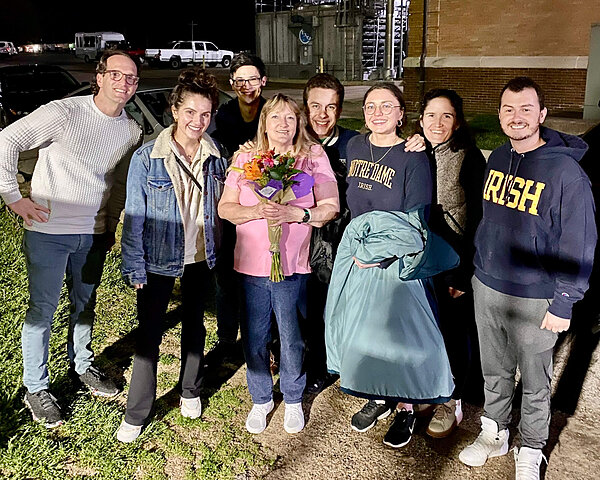
EJC staff attorneys (Elliot Slosar, Kevin Murphy, Nikolai Stieglitz, and Molly Campbell) and students (Riley Realing, Gordon McCormack, and Rachel Schneider) welcome Seabolt upon her release from prison.
Seabolt was released on parole in May 2022 after serving nearly 19 years in prison. At 12:01 a.m. on May 5, 2022, EJC students and attorneys greeted Seabolt as she walked free from Madison Correctional Facility.
Although she had regained her freedom from prison, her murder conviction remained in place for nearly four more years as the EJC continued to litigate her claims of innocence. While this litigation continued, EJC students assisted Seabolt with her reentry and reintegration into society.
“All of my success is due to the help and the friendships that have come out of this horrible situation,” said Seabolt.
EJC students and attorneys helped Seabolt secure housing, transportation, and other resources as she adjusted to life outside prison.
“They helped me find resources that I wouldn't have known how to find because I had been away so long,” she said.
Seabolt also recalled the moment she learned that the EJC would take her case after years of trying to find someone who would listen to her claims of innocence.
“Of course I cried because I spent so many years just trying to get somebody to listen,” she said.
Seabolt with EJC staff attorneys and students at the Indiana Supreme Court for oral argument in 2024
The EJC filed Seabolt's petition for post-conviction relief in June 2021. The petition presented newly discovered evidence, including recantations from key witnesses and evidence of gross police and prosecutorial misconduct in the investigation and prosecution of her case.
In April 2026, Judge Spataro granted Seabolt's petition, vacated her conviction, and ordered a new trial. The court found that the State withheld material exculpatory and impeachment evidence, including evidence concerning misconduct by former Elkhart Police Department Detective Stephen Rezutko, who played a significant role in the investigation and development of witness testimony against Seabolt.
According to court pleadings submitted by the EJC, there was no forensic evidence linking Seabolt to the crime, and the State's case relied heavily on jailhouse informants. Evidence uncovered during post-conviction proceedings showed that Rezutko fabricated witness statements, including by sharing details of the crime with informants to shape their statements and testimony. The State also failed to disclose a video-recorded interrogation of Seabolt's co-defendant threatening to have him “strap[ped]” to a “gurney” and executed if he did not cooperate with the prosecution, a video which Rezutko had previously testified did not exist. Finally, the State failed to disclose internal affairs records documenting that Rezutko had paid his informants in homicide cases for sexual acts.
In his order vacating Seabolt's conviction, Judge Spataro wrote, "The State's blatant violation of Seabolt's rights under the Due Process Clause voids her conviction and, therefore, voids her plea."
For Professor Jimmy Gurulé, founder and director of the Notre Dame Exoneration Justice Clinic, Seabolt's exoneration underscores several significant issues surrounding her case and other wrongful convictions in Elkhart County.
First, the dismissal fully vindicates Seabolt after more than two decades of maintaining her innocence and nearly 19 years of wrongful incarceration.
“Dozens of law students worked on Iris Seabolt’s case over several years. These students used their legal knowledge and training to correct the miscarriage of justice Iris suffered. These students should be commended for their hard work,” Gurulé stated.
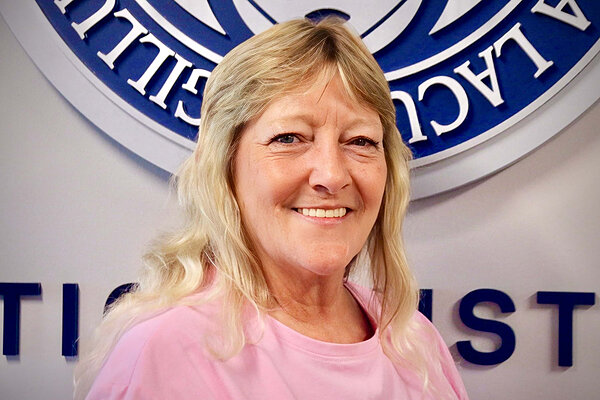
Seabolt with EJC staff attorney Lenora Popken
Among those students was Lenora Popken ’20 J.D., now a staff attorney with the EJC, who began working on Seabolt's case during her first year at Notre Dame Law School.
“After nearly 20 years of wrongful imprisonment, the world finally knows what we have always known—that Iris is innocent,” Popken said. “Fighting alongside her since my first year of law school has been the privilege of a lifetime. Iris’s unwavering strength throughout this decades-long legal battle is nothing short of extraordinary. Today is about long-overdue justice for her, and I am deeply honored to stand with her as both her attorney and her friend.”
Second, beyond Seabolt's case, Gurulé is calling for an independent investigation of every post-conviction case involving Rezutko, with a special prosecutor appointed to conduct the investigation, in light of the malfeasance uncovered in Seabolt's case and evidence of misconduct in other wrongful conviction cases in Elkhart County.
Rezutko has been involved in at least four proven wrongful convictions in Elkhart. Internal affairs investigations also documented misconduct during his tenure with the Elkhart Police Department. In Seabolt's case, Judge Spataro found that she had been deprived of evidence that could have been used to challenge both the State's case and Rezutko's credibility.
Finally, Seabolt's case adds to a troubling history of wrongful convictions in Elkhart County. According to the National Registry of Exonerations, Seabolt’s exoneration marks the eighth exoneration in Elkhart County since 1989. There are now more proven wrongful convictions in Elkhart County than any other county in Indiana, including Marion County.
“Elkhart County holds the record of being the exoneration capital of Indiana,” said Gurulé.
Seabolt's exoneration marks the EJC's fifth exoneration, after the exonerations of Reginald "Reggie" Dillard in February 2026, Kara Beaty in April 2025, Anthony Bedolla in August 2024, and Andy Royer in July 2021.
Clinic investigator Christian Sheckler, executive assistant Anne Peterson, and staff attorneys Lenora Popken and Kevin Murphy with Seabolt
Gurulé praised the EJC team that investigated and litigated Seabolt’s case, which included staff attorney and term teaching professor Kevin Murphy '14 J.D., staff attorney Lenora Popken '20 J.D., executive assistant Anne Peterson ‘92, ‘02 J.D., adjunct professor Elliot Slosar, and at least 11 EJC students since 2021. Exoneration Project investigator Patti Fayed also worked on Seabolt’s case.
“I am so proud of the army of Notre Dame Law School students who fought for justice for Iris over the past several years,” Murphy said. “Their work was in the best tradition of Notre Dame lawyers.”
For Seabolt, her exoneration brings not only the clearing of her name, but gratitude for the people who stood beside her throughout the process.
“I am thankful to God for finally clearing my name and for using the people that He used to do it, because now, I have a whole other family,” Seabolt said.
Since its founding, the EJC has remained committed to criminal justice reform, litigating wrongful conviction cases, and educating the public about miscarriages of justice.
Learn more about the Notre Dame Exoneration Justice Clinic at exoneration.nd.edu.
EJC staff attorneys and students with Seabolt at a celebration of her exoneration
Reflections from Exoneration Justice Clinic Students
Rachel Schneider ‘23 J.D.
"Being there at midnight at a Southern Indiana prison to see Iris released from custody is a memory I will cherish forever. Iris is the most selfless, kind, hilarious, and most deserving woman I’ve met. While the courts cannot give her back the decades Elkhart stole from her, I am so happy that this day has come and I could not be prouder to have had a small role in her case. I carry my memories of Iris and the injustices she’s faced with me every day."
Riley Realing ‘23 J.D.
"Working on Iris's case was one of the most meaningful experiences of my law school career. I will never forget driving down to the Kentucky border the day she was released to pick her up at exactly 12:01 a.m. It was so special to be there and welcome her home."
Iris Seabolt's Current Student Team: Third-year law students Jake Mequet, Anna Capps, and Thatcher Maconga
"It has been a privilege to assist with Iris's representation and to work alongside the EJC attorneys, staff, and students whose dedication and resolve made this result possible. Working on Iris's case has been one of the most fulfilling parts of our law school experience. We are grateful to have played even a small part in the effort to bring Iris the justice she deserves."
Originally published by Arienne Calingo at law.nd.edu on September 02, 2026.
]]>
Arienne Calingotag:exoneration.nd.edu,2005:News/1849502026-08-20T14:00:00-04:002026-08-20T14:56:31-04:00ND Law Professor Jimmy Gurulé Leads Trainings for Mexican Foreign Affairs Officials and Advances the Program for the Defense of Mexican NationalsProfessor Jimmy Gurulé and Katie Takeuchi meet with Undersecretary Cristina Planter Riebeling in Mexico City to discuss the Program for the Defense of Mexican Nationals
Notre Dame Law Professor Jimmy Gurulé, founder and director of the Notre Dame Exoneration Justice Clinic (EJC), conducted two four-hour training sessions on August 13-14 at Mexico's Directorate-General for Consular Protection and Strategic Planning, a division of the country's Secretaría de Relaciones Exteriores (Ministry of Foreign Affairs). Katie Takeuchi, staff attorney at the EJC, joined Gurulé in Mexico City to facilitate the sessions. The training covered major causes of wrongful conviction, procedures for evaluating cases for the Program for the Defense of Mexican Nationals (PDM), and an overview of the American criminal justice system. Fifteen members of Mexico's Ministry of Foreign Affairs participated in the first day of training.
In fall 2023, Mexico's Ministry of Foreign Affairs awarded the EJC a $3 million grant to administer the PDM, a program that provides legal assistance to Mexican nationals facing criminal charges or wrongful convictions in the United States. The program is essential to ensuring that Mexican nationals in the United States receive fair and effective legal representation in a political climate that is hostile to immigrants. The PDM is supported by the Directorate-General for Consular Protection and Strategic Planning, which oversees consular protection and legal assistance for Mexican nationals abroad.
Professor Jimmy Gurulé and Katie Takeuchi pictured with Director General Vanessa Calva Ruiz and her staff at the Directorate-General for Consular Protection and Strategic Planning in Mexico City
In addition to the training sessions, Gurulé and Takeuchi met with Cristina Planter Riebeling, Undersecretary for North America at the Ministry of Foreign Affairs, and Vanessa Calva Ruiz, Director General of Consular Protection and Strategic Planning.
“The PDM has attracted a high level of interest and attention within the Ministry of Foreign Affairs,” said Gurulé.
Planter Riebeling expressed strong support for the PDM and asked how her office could further support the program and help ensure its continued success. Gurulé said Planter Riebeling described the PDM as one of the Ministry of Foreign Affairs' top priority programs.
Following the meeting, Planter Riebeling wrote, “The meeting provided an opportunity to highlight the important results achieved through the program and discuss next steps.” She also expressed appreciation for the “excellent collaboration” that the Ministry of Foreign Affairs has developed with Gurulé and his team.
Professor Jimmy Gurulé and Katie Takeuchi in a meeting with Undersecretary Cristina Planter Riebeling, Director General Vanessa Calva Ruiz, and other Ministry of Foreign Affairs officials
“I'm in regular communication with Director General Vanessa Calva Ruiz and her staff on the cases that we're accepting for legal representation, giving them updates on the progress that we're making,” said Gurulé.
During their visit to Mexico City, Gurulé and Takeuchi also met with Maria Mercedes Salmon, director of Notre Dame Mexico, and Dr. Imer Flores, research professor of law at the National Autonomous University of Mexico (UNAM) Faculty of Law, to discuss their support for the PDM.
Gurulé and Takeuchi met with Salmon to discuss the future of the PDM and Notre Dame Law School's growing presence in Mexico. “The PDM is one of the crown jewels of Notre Dame's presence in Mexico City,” Gurulé said.
Their meeting with Flores focused on ways to further strengthen the relationship between Notre Dame Law School and the UNAM Faculty of Law, particularly through the EJC's summer internship program. This summer, two UNAM students participated in the program on Notre Dame's campus.
“Overall, I thought it was a very productive visit,” said Gurulé. “In our short two-and-a-half-year relationship with the Directorate-General for Consular Protection and Strategic Planning, we've had a really substantial caseload. The PDM is really functioning. It's being fully implemented and operating on all cylinders.”
Originally published by Arienne Calingo at law.nd.edu on August 20, 2026.
]]>
Arienne Calingotag:exoneration.nd.edu,2005:News/1816902026-05-13T09:36:00-04:002026-05-13T09:36:45-04:00Syl and Vicki Schieber Make Generous Gift to Support Death Penalty Abolition Week at Notre Dame Law School for Five YearsSyl Schieber ’72 M.A., ’74 Ph.D., speaking at the inaugural Death Penalty Abolition Week in March 2025
Syl Schieber ’72 M.A., ’74 Ph.D., and his wife, Vicki, have made a generous gift to support Notre Dame Law School’s Death Penalty Abolition Week for the next five years. Their contribution will help ensure the event’s continuation and support the Law School’s efforts to raise awareness of the tragic miscarriages of justice caused by wrongful convictions, affirm the sanctity of human life, and advocate for the abolition of the death penalty. This latest gift builds on a previous gift from the Schiebers in fall 2025 supporting Death Penalty Abolition Week.
Distinguished speakers—including death row exonerees, abolition advocates, and experts in criminal justice reform—shared firsthand accounts and discussed systemic issues tied to wrongful convictions and capital punishment, such as racial bias and the fundamental violation of human dignity inherent in the death penalty.
Featured speakers have included Dr. Yusef Salaam, Central Park Five exoneree and New York City Councilman; Ohio death row exonerees Lamont Hunter and Elwood Jones, both represented by attorney Erin Gallagher Barnhart ’05 J.D. in separate cases; Sister Helen Prejean, author of Dead Man Walking: An Eyewitness Account of the Death Penalty in the United States; the Honorable Bob Morris, Indiana Representative; Anthony Ray Hinton, death row exoneree and author of the novel The Sun Does Shine; Donna Schneweis, director of the Kansas Coalition Against the Death Penalty; and Sarah Craft, interim director of the Indiana Abolition Coalition.
Syl Schieber also spoke at both the inaugural and second annual Death Penalty Abolition Week, sharing a powerful testimony rooted in faith, forgiveness, and justice. After his 23-year-old daughter, Shannon, was raped and murdered in 1998, Schieber and his wife made the decision to oppose capital punishment for her killer. Guided by their Catholic faith and belief in the sanctity of human life, the Schiebers have since become leading voices in the national movement to abolish the death penalty. He shared his story at the inaugural Death Penalty Abolition Week last year and, this year, moderated a panel discussion titled “A Call to Action” with panelists Schneweis and Craft, reflecting on how he turned his grief into action.
Through their gift supporting Death Penalty Abolition Week at Notre Dame Law School over the next five years, the Schiebers reaffirm their commitment to faith, forgiveness, and the abolition of the death penalty. Professor Jimmy Gurulé, director of the Exoneration Justice Clinic, stated that “while the generous gift from Syl and Vicki Schieber will continue to support the Death Penalty Abolition Week for the next five years, the ultimate goal is to abolish the death penalty in Indiana within that period of time, if not sooner.”
Originally published by Arienne Calingo at law.nd.edu on May 13, 2026.
]]>
Arienne Calingotag:exoneration.nd.edu,2005:News/1814592026-05-06T08:30:00-04:002026-05-06T09:30:16-04:00Notre Dame Exoneration Justice Clinic Client Iris Seabolt’s Murder Conviction Vacated, New Trial OrderedAttorneys and students from the Notre Dame Exoneration Justice Clinic, along with client Iris Seabolt, attended oral argument at the Indiana Supreme Court in 2024.
On Wednesday, April 22, Judge Christopher Spataro of the Elkhart Superior Court granted Notre Dame Exoneration Justice Clinic (EJC) client Iris Seabolt’s petition for post-conviction relief (PCR), vacating her wrongful murder conviction and ordering a new trial.
Seabolt was convicted of felony murder in 2004 in connection with the August 1, 2000 killing of A.J. Williams in Elkhart, Indiana. After the State presented its case at trial, Seabolt entered a guilty plea and was later sentenced to 45 years in prison. She attempted to withdraw her plea at sentencing, maintaining her innocence, but the request was denied.
In his order, Judge Spataro found that Seabolt’s conviction was fundamentally undermined by constitutional violations, including the State’s failure to disclose critical evidence. “The State’s blatant violation of Seabolt’s rights under the Due Process Clause voids her conviction and, therefore, voids her plea,” he wrote.
The court’s decision centers on newly uncovered evidence showing that the State withheld material exculpatory and impeachment evidence, including information about misconduct by former Elkhart Police Department Detective Stephen Rezutko. According to the court’s findings, Rezutko played a significant role in the investigation and the development of witness testimony used against Seabolt.
At trial, the State’s case relied heavily on jailhouse informants, as there was no forensic evidence linking Seabolt to the crime. Evidence presented during post-conviction proceedings revealed that Rezutko fabricated or influenced witness statements, including by sharing details of the crime with informants to shape their testimony. In one instance, another investigator testified that he withdrew from the case after discovering Rezutko had shown crime scene photographs to a jailhouse informant to help generate a statement.
The court also found that the State failed to disclose a video-recorded interrogation of Seabolt’s co-defendant, which Rezutko had previously testified did not exist, as well as internal affairs records documenting Rezutko’s misconduct, including paying informants for sexual acts.
Professor Jimmy Gurulé, faculty director of the Notre Dame Exoneration Justice Clinic, stated, “Detective Stephen Rezutko has been implicated in several other wrongful conviction cases in Elkhart County. Who knows how many innocent people have been falsely convicted and deprived of their freedom because of Rezutko's illegal conduct. The EJC will continue to fight for justice in Elkhart County and beyond.”
Judge Spataro emphasized the significance of this undisclosed evidence in evaluating Seabolt’s guilty plea:
“When Seabolt pled guilty, the State had presented its entire case against her. She had no knowledge that the State’s case against her rested on fabricated evidence and the integrity of a detective who had lied under oath, lied in internal investigations, coerced witnesses during interrogations, and paid his informants for sexual acts. She was constitutionally entitled to all of this evidence to attack the integrity of the State’s case and prove her innocence, but it was withheld from her. Seabolt’s decision to accept a plea was not in any sense ‘knowing’ because the State withheld from her evidence that would have directly impacted her decision. The Constitution does not permit such a miscarriage of justice.”
The Notre Dame Exoneration Justice Clinic filed Seabolt’s petition for post-conviction relief in June 2021. The petition alleged that newly discovered evidence—including recantations from key witnesses—demonstrated her innocence and exposed systemic misconduct in the investigation and prosecution of her case.
Seabolt was released on parole in May 2022 after serving nearly 19 years in prison. Despite her release, her conviction remained in place until this ruling.
The court’s decision vacates Seabolt’s conviction and grants her a new trial. However, she has not yet been fully exonerated. The State retains the option to appeal the ruling or retry the case.
The decision marks a significant development in a case that has spanned more than two decades and raises broader concerns about the use of jailhouse informants, disclosure obligations, and the integrity of criminal investigations.
Learn more about the Notre Dame Exoneration Justice Clinic at exoneration.nd.edu.
Originally published by Arienne Calingo at law.nd.edu on May 06, 2026.
]]>
Arienne Calingotag:exoneration.nd.edu,2005:News/1809352026-04-20T15:52:00-04:002026-04-20T16:32:21-04:00UNAM Law Students Join Notre Dame Exoneration Justice Clinic Summer Internship Program
The Notre Dame Law School Exoneration Justice Clinic (EJC) will welcome three law students from the National Autonomous University of Mexico (UNAM) to its summer internship program. The students will work on wrongful conviction cases while gaining hands-on experience in criminal justice advocacy.
Beginning June 1, 2026, the UNAM students will spend four weeks at the University of Notre Dame collaborating with students from Notre Dame Law School on cases involving Mexican nationals wrongfully convicted of a crime they did not commit. The work will be conducted through the Program for the Defense of Mexican Nationals (PDM), a dimension of the EJC that provides legal assistance to Mexican nationals facing criminal charges or wrongful convictions.
“This is an exciting development that distinguishes the EJC from other law school innocence clinics in the country,” said Professor Jimmy Gurulé, founder and director of the EJC.
The participating UNAM students include Diana Estefanía Bolaños Cuevas, Griselda Carina Santos Garnica, and Juan Gerardo Talavera Cervantes. The students were selected by Dr. Imer Flores, research professor of law at the UNAM Faculty of Law. They will join two students from Strathmore Law School—Notre Dame Law School’s partner institution in Nairobi, Kenya—who will participate as EJC/PDM summer interns for three weeks.
Since 2021, the EJC’s summer internship program has hosted diverse cohorts of students from Notre Dame Law School, Strathmore Law School, and undergraduate programs at the University of Notre Dame and St. Olaf College. The interns work primarily on intake cases, reviewing several requests for legal representation and recommending whether to accept or reject cases based on a rigorous screening process. They also assist in ongoing EJC/PDM cases, gaining firsthand experience investigating claims of innocence and understanding the process of building a case.
By adding UNAM law students, the EJC’s summer internship program expands its international collaboration while strengthening the clinic’s ability to serve clients whose cases span languages and cultural contexts. The program also advances Notre Dame Law School’s strategic priority of building ties with leading international legal and academic institutions and educating students to serve clients in an increasingly interconnected world.
“The future of legal practice is not confined by national borders, and our students must be prepared to serve clients and communities across cultures and legal systems,” said G. Marcus Cole, the Joseph A. Matson Dean of Notre Dame Law School. “Welcoming students from UNAM into the work of the Notre Dame Law School Exoneration Justice Clinic reflects the Law School’s commitment to forming lawyers and leaders dedicated to justice. This collaboration advances our mission by combining rigorous legal training with the pursuit of justice in a way that is deeply consistent with our Catholic tradition.”
The collaboration builds on existing connections between the two institutions. Gurulé previously spoke at the UNAM Faculty of Law—Mexico’s largest law school—in October 2025, where he discussed the PDM as well as the importance of law school clinics and the pedagogy of clinical education. He emphasized the value of hands-on legal experience in preparing students for the practice of law.
The addition of UNAM students to the EJC’s summer internship program marks another step in the clinic’s efforts to combine experiential education with meaningful service, providing students with practical training while furthering the cause of justice.
Learn moreabout the Notre Dame Law School Exoneration Justice Clinic at exoneration.nd.edu.
Originally published by Arienne Calingo at law.nd.edu on April 20, 2026.
]]>
Arienne Calingotag:exoneration.nd.edu,2005:News/1806262026-04-06T14:30:00-04:002026-04-06T14:49:11-04:00Notre Dame Law School’s Second Death Penalty Abolition Week Deepens the Call for Justice, Redemption, and Human DignityAnthony Ray Hinton and Professor Jennifer Mason McAward
Notre Dame Law School hosted its second annual Death Penalty Abolition Week from Monday, March 23 to Friday, March 27, 2026. Organized by the Notre Dame Law School Exoneration Justice Clinic, with the Klau Institute for Civil and Human Rights and the Institute for Social Concerns serving as co-sponsors, the week was made possible through a generous donation from Syl Schieber ’72 M.A., ’74 Ph.D., and Vicki Schieber. Several student organizations at Notre Dame Law School also co-sponsored the events, including the American Constitution Society, the Notre Dame Exoneration Project, Jus Vitae, the Women’s Legal Forum, the National Lawyers Guild, and the Death Penalty Abolition Society.
Through a series of powerful conversations and firsthand accounts, Death Penalty Abolition Week sought to raise awareness of the tragic miscarriages of justice caused by wrongful convictions, affirm the sanctity of human life, and advocate for the abolition of the death penalty in the United States. Featuring exonerees, advocates, and experts committed to criminal justice reform, the week invited the Notre Dame community to reflect deeply on the emotional, legal, and moral impact of the death penalty and the urgent need for change. Explore key takeaways from each speaker below.
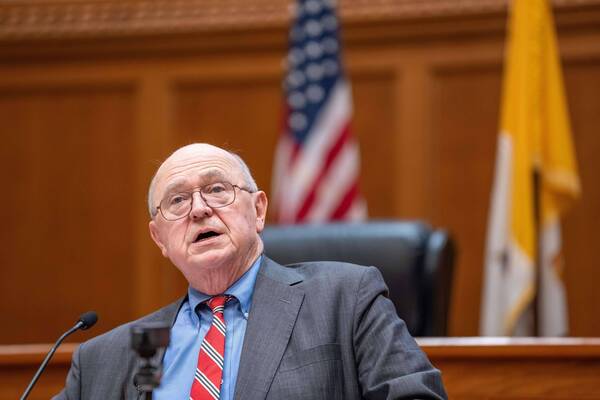
Honorable Bob Morris, Indiana Representative, Legislative Efforts to Repeal the Death Penalty in Indiana
Honorable Bob Morris
To open Death Penalty Abolition Week, Notre Dame Law School welcomed the Honorable Bob Morris, Indiana Representative, for a discussion moderated by Professor Jimmy Gurulé, founder and director of the Notre Dame Law School Exoneration Justice Clinic. Opening remarks were delivered by Dean G. Marcus Cole.
In his remarks, Dean Cole framed the conversation around human dignity and moral responsibility, emphasizing the Church’s teaching on capital punishment. He noted that the death penalty risks depriving the guilty of the possibility of redemption, adding, “Consequently, the Church teaches in the light of the Gospel that the death penalty is inadmissible.” His remarks set the tone for a discussion centered not only on law and policy, but also on faith, justice, and the value of human life.
Representative Morris spoke candidly about his legislative efforts to repeal the death penalty in Indiana, including his sponsorship of House Bill 1030. Grounded in his Catholic faith, Morris emphasized the principles of human dignity and the possibility of redemption, even for those who have committed the most serious crimes.
“Looking at the big picture, today we can house these people and feed them. We don’t have to kill them. How are they going to learn the difference between right and wrong?” he said, urging the audience to reconsider whether execution serves justice.
He also highlighted the transformative potential of redemption, asking, “If I told you that that prisoner brought one more person to Jesus Christ, would that change your mind?” He continued, “It sure should. They found Christ while they were in prison. The point is, if they bring one person to Christ, I think we should stop capital punishment in the state of Indiana because of that—because they found Christ and may go on to evangelize others.”
Morris also reflected on the bipartisan nature of his work, noting that efforts to abolish the death penalty have brought together unlikely allies across political lines. “Every single Democrat was voting with me on this—and I’m a pro-life legislator. It is but an interesting journey,” he said, pointing to a shared commitment to protecting life despite differing political perspectives.
Professor Gurulé closed the discussion by thanking Morris for his advocacy, stating, “Thank you for your strong leadership on this very important issue that has divided our country. I really do believe you are a profile in courage.”
Together, the discussion underscored how questions of justice, faith, and policy continue to shape the evolving conversation around capital punishment.
Erin Barnhart and Elwood Jones, federal public defender and Ohio death row exoneree, Defending the Innocent from Wrongful Execution
Erin Barnhart and Elwood Jones
The second day of Death Penalty Abolition week included an emotional conversation with Notre Dame Law alumna Erin Barnhart ‘05 J.D., federal public defender, and her client Elwood Jones, an Ohio death row exoneree. Jones is an innocent man who spent nearly 30 years on death row after being falsely convicted of one count of aggravated murder, one count of aggravated burglary, and one count of aggravated robbery. Together, Jones and Barnhart shared the details of his typical workday at an Embassy Suites hotel which ended in his wrongful conviction and 30 years of imprisonment.
The talk included extensive details of the day of the murder, the botched police investigation that followed, and the trial which left Jones sentenced to a crime he did not commit. Barnhart explained the pivotal evidence and alternative suspects which were simply ignored by police and prosecutors as they narrowed in on Elwood from the beginning.
“The investigation showed incredible signs of tunnel vision and confirmation bias, and ignored really viable leads. They zeroed in on Elwood to the exclusion of anyone else. The state withheld nearly 4,000 pages of materials including investigative notes and witness statements which pointed to alternative suspects,” Barnhart explained.
Jones was finally exonerated after almost three decades on death row. Since his release in December 2022, he has devoted his life to others through constant volunteer work. Jones reflected on his life since his release, stating, “When I was in there, I lost a lot. I lost my parents, I lost my wife, and I lost two of my sisters. They took my life and turned it upside down. I had something before I got locked up. Now, I’ve got nothing. So, what do I do today? I volunteer in Cincinnati, I feed the homeless, I go to a school and read to little kids. On the side, I make teddy bears and gift them to anyone who has helped me.”
Jones and Barnhart’s conversation offered a powerful reminder of the human cost of wrongful convictions and the urgent need for accountability within the criminal justice system. Their story underscored both the devastating consequences of injustice and the resilience required to rebuild a life after it.
Anthony Ray Hinton, Enduring 30 Years on Death Row in Alabama
Anthony Ray Hinton
On Thursday, Anthony Ray Hinton, distinguished activist and author of the novel The Sun Does Shine, delivered his personal experience of 30 years on death row after a false conviction. At age 29, with no history of violent crime, Hinton was convicted of two counts of murder due to flawed evidence and a racist system in Alabama. He spent almost three decades on death row until he was finally exonerated and released on April 3, 2015.
During his talk, moderated by Professor Jennifer Mason McAward, Hinton shared the emotional details of his 30 years in solitary confinement in a 5×7 cell. He described the constant noise day and night, the 2:00 a.m. wakeups each morning, and the lack of decent food and sleep. Hinton also shared the relationships he formed with the others on death row, and how he even convinced the guards to allow him to start a book club amongst the inmates.
“I didn’t just spend 30 years on Alabama death row. I spent 30 years in pure Hell. It is so important for all of us to look at the death penalty in this country and do something about it,” he said.
Hinton also recalled that upon his arrest, the arresting officer told him that five specific, racially motivated factors would guarantee his conviction for a crime he did not commit. Dismissing Hinton’s innocence, the officer outlined the following reasons: (1) You’re Black, (2) A white man is going to say you shot him, (3) You’re going to have a white prosecutor, (4) You’re going to have a white judge, and (5) You’re going to have an all-white jury.
“I don’t care whether you did or didn’t do it,” Hinton recalled the officer telling him. “But I’m going to make sure you’re found guilty of it. There are five things they’re going to convict you on. Do you know what that spells? Conviction, conviction, conviction, conviction, conviction.”
The arresting officer’s statements underscored the racial discrimination deeply entrenched in the death penalty system.
Hinton urged Notre Dame Law School to consider his case as one of many wrongful convictions in which society cast him out and stopped treating him as a human being. He has spent the past 11 years since his exoneration devoted to sharing his personal story and strongly advocating for the abolition of the death penalty.
“I am hoping, I am praying, that some of you men and women become lawyers who can fight for those who cannot fight for themselves,” said Hinton. “I ask you to stand up and fight for me and the death penalty. I challenge every man and every woman here to do your research. Justice did not work. Had justice worked, I would not have been indicted in the first place. It was only a lawyer who cared enough to give me justice and freedom.”
Hinton’s testimony served as a powerful call to action, urging future lawyers to confront injustice and advocate for those whose voices have been silenced. His story reinforced the profound responsibility of the legal profession to pursue justice with integrity, compassion, and humanity.
Sarah Craft, Donna Schneweis, and Syl Schieber, A Call to Action
Donna Schneweis, Syl Schieber, and Sarah Craft
On the last day of Death Penalty Abolition Week, Syl Schieber moderated a discussion with Donna Schneweis, director of the Kansas Coalition Against the Death Penalty, and Sarah Craft, interim director of the Indiana Abolition Coalition.
Schieber opened the conversation by sharing the personal story that shaped his advocacy. After the murder of his daughter Shannon on May 7, 1998, he publicly opposed the use of the death penalty in her case, even as prosecutors chose to pursue it. Reflecting on that experience, he noted that victims’ families are not always heard when they oppose capital punishment, a realization that led him to turn grief into action.
“I began publicly organizing,” Schieber said, describing how his work grew into a national effort involving legislators, service organizations, and faith communities. He emphasized that meaningful change requires sustained, state-level engagement—“boots on the ground all over the country”—given that death penalty policy is often determined locally.
Craft then provided an overview of the current landscape in Indiana, describing a system shaped by executive authority and shifting political priorities. Although the state carried out no executions between 2009 and 2024, she explained that executions resumed in December 2024, with two more following soon after. “What we’re seeing is a rise in executions, not a rise in death sentences,” she said, underscoring renewed urgency for advocates. Craft also pointed to the risk of wrongful convictions, noting that Indiana has had two death row exonerations, and highlighted the high costs of lethal injection protocols.
She described emerging bipartisan dynamics, including alliances with legislators such as Representative Bob Morris, and framed Indiana as a “microcosm of what’s going on around the country.” For Craft, the path forward lies in what she called “abolition by attrition”—gradually narrowing the use of the death penalty until it can no longer be sustained.
Schneweis offered a parallel perspective from Kansas, where the death penalty remains legal but rarely used. She traced the state’s complex history, noting that Kansas has carried out relatively few executions in its history, with none since 1965, and has not seen a capital conviction since 2015. Despite high-profile cases that can intensify public support for capital punishment, she emphasized the strength of a growing bipartisan coalition working toward repeal. “Republicans are willing to support repeal,” she said, pointing to legislative efforts such as House Bill 2272 and Senate Bill 245 as evidence of cross-party momentum.
Schneweis also highlighted the coalition’s dual strategy of pursuing repeal while defending against efforts to expand execution methods, including proposals like nitrogen gas. Bringing together religious advocates and fiscal conservatives, she noted, has been key to advancing the conversation in a politically diverse state.
Together, these conversations offered a profound reflection on the moral, legal, and human dimensions of the death penalty, challenging the Notre Dame Law School community to engage more deeply with issues of justice, dignity, and accountability. Through the voices of those directly impacted and those actively working toward reform, Death Penalty Abolition Week reaffirmed the importance of advocacy, compassion, and a steadfast commitment to protecting human life.
Learn more about the Notre Dame Law School Exoneration Justice Clinic at exoneration.nd.edu, the Klau Institute for Civil and Human Rights at klau.nd.edu, and the Institute for Social Concerns at socialconcerns.nd.edu.
Originally published by Notre Dame Law School at law.nd.edu on April 06, 2026.
]]>
Notre Dame Law Schooltag:exoneration.nd.edu,2005:News/1794942026-02-24T11:45:00-05:002026-02-24T13:36:01-05:00Notre Dame Exoneration Justice Clinic Client Reginald “Reggie” Dillard Exonerated After 27 Years of Wrongful ImprisonmentReginald “Reggie” Dillard, a client of Notre Dame Law School’s Exoneration Justice Clinic, is pictured with members of the clinic shortly after his release.
Reginald “Reggie” Dillard, a client of the Notre Dame Law School Exoneration Justice Clinic (EJC), was exonerated on Monday, February 23, after spending 27 years in prison for a crime he did not commit. Dillard was convicted of murder in 2000 based on the 1998 shooting of Christopher Thomas in Elkhart, Indiana, and was sentenced to 65 years in prison. A Special Prosecutor, Marshall County elected prosecutor Nelson Chipman, agreed to vacate Dillard’s conviction on Thursday, February 19, and Judge Christopher Spataro signed the order dismissing the criminal charges, officially exonerating Dillard.
The EJC filed a petition for post-conviction relief on Dillard’s behalf in Elkhart County Superior Court in July 2022. Extensive litigation followed, including proceedings before the Indiana Supreme Court in which the clinic requested the assignment of an impartial judge. After a Special Judge and a Special Prosecutor were appointed, the court held a two-day evidentiary hearing that began last Wednesday, February 18, and concluded on Thursday, February 19.
Reggie Dillard is pictured with members of the Notre Dame Law School Exoneration Justice Clinic following the evidentiary hearing.
The EJC presented new evidence at the evidentiary hearing last week. Following the close of evidence, the Special Prosecutor concluded that Dillard’s constitutional rights under Brady v. Maryland had been violated through the withholding of material exculpatory evidence and agreed that his conviction should be vacated. The court entered an order vacating Dillard’s murder conviction, and the following morning, the State moved to dismiss the charges, acknowledging that the evidence did not support retrying the case.
The petition for post-conviction relief filed in 2022 alleged serious misconduct in the investigation and prosecution of the case. Dillard asserted that former Elkhart Police Department Detective Stephen Rezutko fabricated witness statements and maintained an undisclosed sexual relationship with a key witness against Dillard. Following an internal affairs investigation, the Elkhart Police Department found that Rezutko engaged in improper sexual conduct with informants in criminal cases, but this information was not disclosed to defendants, including Dillard, for decades. Dillard also alleged that exculpatory and impeachment evidence was withheld, including benefits provided to key witnesses and compelling evidence implicating two other men in Thomas’s murder.
Reggie Dillard walks out of prison following his exoneration.
In a message to the entire EJC team on the morning of Dillard’s release, Professor Jimmy Gurulé, founder and director of Notre Dame Law School’s Exoneration Justice Clinic, wrote: “As you know, last Thursday, following a two-day evidentiary hearing, Judge Christopher Spataro vacated Reginald Dillard's 2000 wrongful murder conviction. This morning Judge Spataro dismissed the criminal charges against Reggie with prejudice and ordered his immediate release from custody. As the result of the hard work of many of our clinic students, past and present, Reggie has been officially exonerated. Later today, Reggie will regain his freedom and be reunited with his family and friends.”
Immediately after his release, Dillard spoke to members of the EJC who gathered outside the prison to welcome him home, offering a heartfelt message of gratitude and hope.
Reggie Dillard speaks to members of the Notre Dame Law School Exoneration Justice Clinic immediately following his release from prison.
“Thank you. I’ve got a lot of people that care for me,” Dillard said. “There was a time when I was the voiceless, and now I’ve become a voice for the voiceless, and I plan on being that voice.”
EJC staff attorney Kevin Murphy emphasized the broader significance of the exoneration while speaking with Dillard and members of the clinic team outside the prison.
“It’s a day that we also must take to look at this Elkhart criminal justice system and make it better and take a step forward,” said Murphy. “Reggie’s freedom and Reggie’s exoneration today is a huge step along that path. It never would have been possible without so many, especially Elliot Slosar, Reggie’s lead attorney, Professor Jimmy Gurulé with the Exoneration Justice Clinic, and so many Notre Dame law students who fought to help this evidence come to light and help Reggie be free.”
Murphy also addressed Dillard directly: “Reggie, today is your day. This is your story, this is your life. You get to write the ending to it.”
Reggie Dillard is reunited with his fiancée, daughter, and son during a lunch with the EJC team after his release from prison.
Dillard’s case has been one of the clinic’s longest-running matters. Even before the clinic was formally established, Slosar and some volunteer students had been working on Dillard’s case as early as 2018.
Several EJC students played crucial roles in the evidentiary hearing. Third-year law student Andrew Zimlich presented a key piece of evidence that contributed to Dillard’s exoneration.
“It has been an honor and a blessing to play a part in Reggie's exoneration effort,” said Zimlich. “This victory speaks to the hard work of the many students and attorneys who poured their energy and passion into doing justice no matter the obstacles. I will forever be inspired by the incredible grace and resilience that Reggie showed in the face of unimaginable hardship, and I have no doubt that he will go on to inspire countless others.”
Third-year law student Albert Kwon also presented evidence in the case.
“After almost three decades, Reginald Dillard finally walks free,” said Kwon. “It was my honor to contribute to that effort, and his exoneration is a testament to the power of hard work and hope. This result is also a reminder of why the EJC continues to inspire: its mission to correct injustice even in the most difficult, long-fought cases.”
Reggie Dillard and EJC staff attorney Kevin Murphy embrace following Dillard’s release from prison.
Gurulé praised the clinic team that investigated and litigated the case, including Murphy, staff attorney Lenora Popken, legal staff assistant Anne Peterson, and adjunct professor Slosar. He also acknowledged that, along with Zimlich and Kwon, several other clinic students contributed to Dillard’s exoneration.
Dillard’s exoneration is the EJC’s fourth exoneration, after the exonerations of Kara Beaty in April 2025, Anthony Bedolla in August 2024, and Andy Royer in July 2021. Notably, it is the EJC’s third straight exoneration that was achieved with the agreement of the prosecutors on the case. Since its founding, the EJC has remained committed to criminal justice reform, litigating wrongful conviction cases, and educating the public about miscarriages of justice.
Learn moreabout Notre Dame Law School’s Exoneration Justice Clinic at exoneration.nd.edu.
Originally published by Arienne Calingo at law.nd.edu on February 24, 2026.
]]>
Arienne Calingotag:exoneration.nd.edu,2005:News/1760562025-10-27T16:55:00-04:002025-10-27T16:55:26-04:00ND Law Professor Jimmy Gurulé Discusses Exoneration Justice Clinic’s Work in Interview with Renowned Journalist Carmen Aristegui
Last week, ND Law Professor Jimmy Gurulé was interviewed by Carmen Aristegui, widely regarded as one of Mexico's most prominent journalists, to discuss the work of the Notre Dame Exoneration Justice Clinic (EJC) and the Program for the Defense of Mexican Nationals in Criminal Matters in the United States (PDM). Ms. Aristegui, known for her fearless reporting on government corruption in Mexico, received the 2023 “World Press Freedom Hero” award from the IPI-IMS, the world’s premier international press organization. Professor Gurulé is the founder and faculty director of the EJC and a former federal prosecutor.
Supported by Mexico’s Ministry of Foreign Affairs, the PDM was established in 2023 to provide legal assistance to Mexican nationals who have been wrongfully convicted or who are facing criminal charges in the United States. Professor Gurulé emphasized that “this program is more important today than ever” given the ongoing restrictions and stigmatization of immigrants in the U.S. He also noted that “there is no other program like this." The PDM is part of the EJC, which is the only law clinic in the country to receive funding from a foreign government to represent foreign nationals nationwide.
The PDM handles approximately 15 cases across 11 U.S. states, including California, Texas, and New York. About 40 law students are enrolled in the EJC at Notre Dame Law School this semester, and several of them directly work on PDM cases.
In addition to his interview with Ms. Aristegui, Professor Gurulé spoke at Mexico’s largest law school, the Facultad de Derecho at the Universidad Nacional Autónoma de México (UNAM). He spoke about the PDM and highlighted the importance of law school clinics and the pedagogy of clinical education, emphasizing the value of hands-on legal experience in preparing students for the practice of law.
Read the full article (in Spanish) on Aristegui Noticias here.
Watch the full interview (in Spanish) with Carmen Aristegui below:
]]>
Arienne Calingotag:exoneration.nd.edu,2005:News/1751422025-09-22T10:10:00-04:002025-09-22T10:11:53-04:00Syl and Vicki Schieber Make Generous Gift to Fund Notre Dame Law School's Death Penalty Abolition Week
Syl Schieber ’72 M.A., ’74 Ph.D., and his wife, Vicki, have made a generous gift to support Notre Dame Law School’s Death Penalty Abolition Week. Their contribution will help ensure that the event continues in the future.
In March 2025, the Notre Dame Law School Exoneration Justice Clinic (EJC) and the Klau Institute for Civil and Human Rights organized the inaugural Death Penalty Abolition Week, a four-day series of events that examined the realities of wrongful convictions and sparked critical conversations about the use of capital punishment. Distinguished speakers—including exonerees, advocates, and experts in criminal justice reform—shared firsthand accounts and discussed systemic issues tied to wrongful convictions and capital punishment, including racial bias against defendants of color and the fundamental violation of human dignity inherent in the death penalty.
Schieber was among the featured speakers, sharing a powerful testimony grounded in faith, forgiveness, and justice. After his 23-year-old daughter, Shannon, was raped and murdered in 1998, Schieber and his wife made the decision to oppose capital punishment for her killer. Guided by their Catholic faith and belief in the sanctity of human life, the Schiebers have since become prominent voices in the national movement to abolish the death penalty.
Through their generous donation to fund Death Penalty Abolition Week at Notre Dame Law School, the Schiebers demonstrate their dedication to faith, forgiveness, and the ongoing fight to abolish the death penalty.
Originally published by Arienne Calingo at law.nd.edu on September 22, 2025.
]]>
Arienne Calingotag:exoneration.nd.edu,2005:News/1749902025-09-15T23:45:00-04:002025-09-16T00:06:31-04:00Exoneration Justice Clinic Victory: Jason Hubbell’s 1999 Murder Conviction Is VacatedMembers of the EJC team, from left to right: Eric Wahoff '25 J.D., Megan Sarsfield '25 J.D., 3L Alex Ragland, 1L Katherine Mojica, Jason Hubbell, 3L Autumn Chassie, EJC staff attorney Lenora Popken, Adam Miller '25 J.D., EJC staff attorney Kevin Murphy, and adjunct professor of law Elliot Slosar
This past Friday, September 12, Bartholomew County Circuit Court Judge Kelly S. Benjamin entered an order vacating Exoneration Justice Clinic (EJC) client Jason Hubbell’s 1999 convictions for murder and criminal confinement based on the State of Indiana’s withholding of material exculpatory evidence implicating another man in the murder.
In 1999, Hubbell was wrongfully convicted of the 1997 abduction and murder of Sharon Myers. He was sentenced to 75 years in prison and has served over 26 years. In October 2022, the EJC took on Hubbell’s case on a pro bono basis. This past February, EJC attorneys and students participated in a week-long evidentiary hearing at which the EJC presented new evidence implicating Michael Dean Overstreet in Myers’s murder. Michael Dean Overstreet is currently on Indiana’s death row in connection with the September 1997 abduction, rape, and murder of a Franklin, Indiana woman named Kelly Eckart.
As Judge Benjamin found, there were “stunning similarities” between Myers and Eckart’s murders. The two young women were abducted from nearby towns just months apart. Both were abducted from or after leaving their place of work. Both were believed to have been abducted in a van. Both had their shoes removed during their abductions. Both were killed in the Atterbury Wildlife Preserve in between Columbus and Franklin, Indiana. And both were strangled with ligatures that were made from their own clothing. As the judge explained, given these similarities, any information linking Overstreet to Myers or her abduction would have been “significantly favorable evidence” for Hubbell.
Judge Benjamin found that the State had improperly withheld from Hubbell and his attorneys an “overwhelming” amount of exculpatory evidence. Among other things, the State withheld evidence that Overstreet left his home early on the morning of Myers’s abduction and murder, stated that he was going to Myers’s place of employment, was gone all day, and returned home at the end of the day covered in blood. The State also withheld evidence from several unrelated sources that “provided a personal connection between Overstreet and Myers.” When questioned about his role in Myers’s murder at the evidentiary hearing, Overstreet invoked his Fifth Amendment privilege against self-incrimination.
Judge Benjamin further found that the Columbus Police Department’s lead detective on the case “intentionally failed to truthfully inform” Hubbell’s lawyers of this evidence during a pre-trial deposition. She found that this detective “had his sight on one suspect only and that was Hubbell,” and that this “tunnel vision” led the Columbus Police Department to “withhold[] material exculpatory evidence that either implicated Overstreet in Myers’s homicide and/or linked Overstreet to Myers.” The judge also found that this exculpatory evidence had been “intentionally delet[ed]” from the lead detective’s notes on the Myers homicide investigation.
The judge ordered that Hubbell be transported from Indiana prison to Bartholomew County Jail in advance of a status hearing set for October 2, 2025.
According to Professor Jimmy Gurulé, faculty director of the Exoneration Justice Clinic, this outcome was the product of a tremendous team effort by EJC staff and students. EJC staff attorney and term teaching professor Kevin Murphy '14 J.D. led the investigation and litigation of the case, with critical assistance from EJC legal assistant Anne Peterson '93, '02 J.D., EJC staff attorney Lenora Popken '20 J.D., adjunct professor of law Elliot Slosar, and EJC investigator Christian Sheckler. Indianapolis attorney Brent Westerfeld and investigators Denny Butler and Mark Mabrey also made invaluable contributions.
In addition, as Gurulé explained, Notre Dame students played an essential role in the case. “In the past three years, 14 current and former Notre Dame students worked tirelessly on Jason’s case, uncovering new evidence, interviewing witnesses, researching the law, drafting court pleadings and motions, and presenting new evidence in court. This ruling is a testament to their hard work and commitment to correcting the tragic miscarriage of justice and exonerating an innocent man,” Gurulé said.
“Without Jason’s legal team, the system would not have blinked. To fight for someone’s innocence and see the court do Jason justice and vacate his conviction, there is nothing better," said former EJC student Adam Miller '25 J.D. "I am endlessly proud of this EJC team.” Miller worked on the case as a law student in the EJC.
Second-year law student Ella Cain began working on Jason Hubbell’s case in 2023 as an undergraduate student intern at the EJC. Now enrolled in the EJC as a law student, she is once again part of the team working on the Hubbell case. "Working on Jason’s case has been the most profoundly impactful experience of my life. Getting to be a part of the team working toward Jason’s freedom has been not only rewarding but educational. I have gotten to be a part of discovery processes, early-stage drafting of briefs, and client communications," said Cain. She added, "If nothing else, my work at the EJC has taught me that lawyers wield tremendous power to either be a force for good or a force for injustice and that doing what is good will always be the right thing to do."
Originally published by Notre Dame Law School at law.nd.edu on September 15, 2025.
]]>
Notre Dame Law Schooltag:exoneration.nd.edu,2005:News/1740842025-07-30T15:57:00-04:002025-07-30T17:42:46-04:00Notre Dame Law School's Exoneration Justice Clinic: Where Legal Education Meets Justice ReformSt. Olaf College student Norah Langager and Notre Dame undergraduate students Kori Dupree, Jack Yuro, and James Lodenslager
Since its establishment in fall 2020, Notre Dame Law School's Exoneration Justice Clinic has served as a beacon of hope for those who have suffered wrongful convictions while providing students with transformative real-world experience in criminal justice advocacy.
A Mission of Justice and Redemption
Under the direction of Professor Jimmy Gurulé, a former federal prosecutor, the clinic investigates, litigates, and works to overturn wrongful convictions. The clinic has experienced remarkable growth since its founding, with the program continuing to attract diverse and talented students. For summer 2025, the EJC has welcomed 18 student interns: 9 interns in the Exoneration Justice Clinic and 9 interns in the Program for the Defense of Mexican Nationals (PDM), a new dimension of the EJC that broadens the scope of the EJC’s work. The PDM provides legal assistance to Mexican nationals who have been wrongfully convicted or who are facing criminal charges, highlighting the EJC’s commitment to serving distinct client populations through specialized advocacy.
This year's cohort includes law students Shawn Andrew and Brooke Verville from Notre Dame; exchange students Samuel Misembi and Ibrahim Ahmedin from Strathmore Law School in Nairobi, Kenya; Notre Dame undergraduate students James Lodenslager, Kori Dupree, and Jack Yuro; and St. Olaf College students Payton Johnson and Norah Langager. The PDM cohort for this summer includes law students Zoë Bonnichsen, Jeron Melroy, and returning participant Sydni Hart; Notre Dame undergraduate students Esmeralda Ciciaco Sanchez, Joshua Talache-Wheat, Grecia Alcantar, and Mark Valenzuela; and St. Olaf students Sam Laurel and Ruth Feleke.
The clinic's work extends beyond the courtroom, providing exonerated clients access to social support services including education, vocational training, transitional housing, and health care services. This comprehensive approach recognizes that exoneration is just the first step in rebuilding lives shattered by wrongful imprisonment.
Transformative Student Experience
Rising 2L Zoë Bonnichsen
The program provides both law students and undergraduates with invaluable hands-on experience that shapes their understanding of the criminal justice system and their future career aspirations. Students assist in case selection by reviewing requests from Indiana prison inmates, evaluating claims of innocence, and assessing potential avenues for proving innocence through a comprehensive intake process. The experience extends beyond desk work to include prison visits, trial attendance, investigations, and drafting legal pleadings, providing students with a profound understanding of the human impact of wrongful convictions.
Students consistently report that the most meaningful aspects of their internships involve direct client interaction, whether visiting clients in prison or participating in investigations. Professor Gurulé noted that several students in the PDM program are Spanish speakers, which has significantly enhanced the clinic’s work: “Being bilingual enables these students to translate documents written in Spanish and interview witnesses that speak little English. These students are an invaluable asset to the PDM."
For many students, the attraction to the program stems from academic interests that develop into something much deeper. Current law student intern Shawn Andrew said, "I chose to apply to this internship because I was really fascinated by criminal law after my fall semester taking it. I thought that this would be a really impactful sort of thing to do. The second I saw the application, I immediately sent it in."
The program's most profound impact often comes through encounters with those who have been directly affected by wrongful convictions. St. Olaf student Norah Langager reflected on one particularly meaningful experience: "I'd say meeting this woman named Iris [who the EJC has worked with] after she was wrongfully convicted. Seeing her in person and seeing the hope she still has and her drive for life was really inspiring."
Expanding Impact and Recognition
St. Olaf College student Payton Johnson, rising 2L Shawn Andrew, and Strathmore Law School exchange students Ibrahim Ahmedin and Samuel Misembi
The clinic's work has gained recognition well beyond Notre Dame Law School, attracting interest from undergraduate students at Notre Dame, students from other institutions, and even law schools outside the country. This broad appeal reflects the growing awareness of wrongful conviction issues and the importance of the clinic's mission in criminal justice reform.
"We're drawing students from multiple streams—undergraduate students from the Political Science department, Klau Institute for Civil and Human Rights, Institute for Latino Studies, and St. Olaf College, and law students from Notre Dame Law School and Strathmore Law School," said Professor Gurulé.
The program's expansion to include undergraduate students represents a significant evolution in the clinic's approach. The clinic has found that undergraduate students bring valuable enthusiasm, passion, and work ethic that contribute meaningfully to advancing the mission of the EJC, despite their lack of formal legal training. Many of these undergraduate students plan to attend law school, and their work at the EJC provides an invaluable opportunity to conduct legal research and develop foundational skills that will serve them well in their future study of the law.
Looking Forward
St. Olaf College student Ruth Feleke and Notre Dame undergraduate student Mark Valenzuela
As the Exoneration Justice Clinic continues to grow and evolve, it remains committed to its dual mission of seeking justice for the wrongfully convicted or wrongly accused, while providing transformative educational experiences for students at multiple levels. What sets the EJC apart is its rare capacity to offer both pre-trial and post-conviction legal assistance—working not only to overturn wrongful convictions, but also to prevent them from happening in the first place. No other law school clinic in the country provides this comprehensive combination of pre-trial and post-conviction legal assistance.
For students considering their path at Notre Dame Law School or contemplating legal careers, the EJC offers an opportunity to be part of something larger than themselves—a chance to contribute to reforming the criminal justice system while developing the skills and perspectives needed to become effective advocates for justice throughout their careers.
The Exoneration Justice Clinic stands as a testament to Notre Dame Law School's commitment to forming lawyers who will serve as agents of positive change in the world, carrying forward the institution's legacy of faith-informed legal education and service to others. As the program continues to expand and evolve, it remains a beacon of hope for those seeking justice and a transformative educational experience for the next generation of legal advocates.
Learn more about Notre Dame Law School’s Exoneration Justice Clinic at exoneration.nd.edu.
Originally published by Elijah Venter at law.nd.edu on July 30, 2025.
]]>
Elijah Ventertag:exoneration.nd.edu,2005:News/1717382025-04-17T18:00:00-04:002025-04-17T18:10:03-04:00Notre Dame Law School’s Exoneration Justice Clinic Exonerates Kara Beaty
On April 15, 2025, Judge Jeffrey Sanford of St. Joseph County Superior Court No. 3 in Indiana granted Exoneration Justice Clinic (EJC) client Kara Beaty’s petition for post-conviction relief and vacated her conviction for causing death or catastrophic injury to a motorcyclist. Then, on April 17, Judge Sanford granted the State of Indiana’s motion to dismiss the criminal charges against her, officially exonerating Beaty.
Beaty’s wrongful conviction stemmed from a June 2020 collision between Beaty’s vehicle and a motorcyclist. Beaty, who was just 18 years old at the time of the crash, was charged with causing death or catastrophic injury to the motorcyclist while operating a vehicle with a controlled substance in her blood. Beaty was charged under this statute even though she had only trace amounts of THC in her blood from marijuana use a full day before the crash, and she was not impaired at the time of the crash.
At her August 2023 trial, the key issue was whether Beaty in fact caused the collision with the motorcyclist. The State’s case relied on two key pieces of evidence. First, a purported eyewitness testified that he was traveling behind the motorcyclist at the time of the collision and that the motorcyclist was traveling roughly 30 miles per hour. Second, Commander Tim Spencer of the St. Joseph County Fatal Alcohol and Crash Team testified that he determined, based on the distance that the motorcyclist's body was thrown after the crash, that the motorcyclist’s speed was 37-42 miles per hour at the time of the crash. Beaty was convicted based on this evidence and was sentenced to six years in prison, with three years executed at the Indiana Department of Corrections and three years on probation. On October 10, 2023, Ms. Beaty was sent to Indiana prison.
But, evidence never heard by Beaty’s jury proved the State’s theory of the case to be wrong. The motorcyclist had in fact broadcasted his motorcycle ride leading up to the crash on “Facebook Live.” Landmarks visible in this Facebook Live video showed the motorcyclist’s actual route of travel, which contradicted the testimony of the purported eyewitness. In addition, an analysis of landmarks visible in the Facebook Live video showed that the motorcyclist was traveling over 100 miles per hour in the seconds before the crash—nearly three times as fast as the trial evidence suggested.
Based on this evidence, in June 2024, St. Joseph County elected prosecutor Ken Cotter agreed to release Beaty on an appeal bond to allow her to file a petition for post-conviction relief. At that point, Beaty had served over eight months in Indiana prison. The EJC, along with South Bend attorney John Kindley, then litigated Beaty’s petition for post-conviction relief. On March 28, 2025, Beaty and the State filed a joint motion for the Court to summarily grant Beaty post-conviction relief and vacate her conviction. This week, Judge Sanford granted that motion and then granted the State’s motion to dismiss the criminal charges against Beaty.
This successful outcome would not have been possible without the tireless efforts of the entire EJC team, including three of its students: Drew Garden, Autumn Chassie, and Alex Ragland. The students contributed to the case by drafting discovery, researching the factual and legal issues involved in the case, interviewing witnesses, and assisting with deposition preparation.
Beaty’s exoneration is the EJC’s third exoneration and its second in the past year, after the exoneration of Anthony Bedolla in August 2024. Since its founding, the EJC has remained committed to criminal justice reform, litigating wrongful conviction cases, and educating the public about miscarriages of justice.
Learn more about Notre Dame Law School’s Exoneration Justice Clinic at exoneration.nd.edu.
Reflections from the Exoneration Justice Clinic Team:
“This was a joint effort with the EJC and St. Joseph County Prosecutor’s Office that joined our motion to vacate Kara’s wrongful conviction. While Kara should never have been convicted of these crimes in the first place, ultimately, justice was done.”
Kevin Murphy, Staff Attorney and Term Teaching Professor:
"Kara's wrongful conviction was particularly devastating because it sent a young woman who had her life ahead of her to prison for a crime that she did not commit. It was a privilege to represent Kara and help undo this tragic injustice. We hope that our work on Kara's case will help her put this horrible chapter of her life behind her."
"Kara's wrongful conviction stole from her the critical years of personal development that occur after high school graduation. While her exoneration will not give her back that time, it will allow her to heal and move forward. I cannot wait to see her grow and develop into the person she is meant to be now that this weight is off of her shoulders."
Drew Garden, 3L:
"When the jailhouse door slams behind an innocent person, it can feel like the world has ended. Exoneration work is special because with careful litigation and hard work, we're able to pry that door open and give people their lives back. I'm so happy for Kara and her family, and I'm inspired as always by our dedicated attorneys at the EJC."
Autumn Chassie, 2L:
“It has been a privilege to assist in Kara Beaty’s representation and contribute to the clinic’s work in any way I can. I am deeply grateful for the opportunity to stand alongside Kara in her fight for justice and to be part of a team so unwavering in its commitment to righting wrongful convictions.”
Alex Ragland, 2L:
“After being wrongfully convicted, getting her conviction vacated is a victory for Kara and for the clinic. We all did extensive research into Kara's case, and I'm so happy that our work helped lead to this fantastic result.”
]]>
Notre Dame Law Schooltag:exoneration.nd.edu,2005:News/1717062025-04-16T15:59:00-04:002025-04-16T16:11:02-04:00Statement from Professor Jimmy Gurulé, Director of the Notre Dame Exoneration Justice Clinic, and Winnie Ye, State Policy Advocate for the Innocence Project, on the Passage of Indiana’s Amended Senate Bill 141
Today, the Indiana legislature recognized the importance of preventing wrongful convictions by passing Senate Bill 141 which will implement three nationally recognized practices for conducting eyewitness identifications and set guardrails for law enforcement’s use of facial recognition technology. We especially want to thank sponsors Senator Liz Brown (R-Fort Wayne) and Representative Greg Steuerwald (R-District 40) for their leadership on this important issue. While the final version excludes double blind administration, a key component of the Core Four practices that prevents unintentional suggestiveness or influence from law enforcement, Senate Bill 141 is a positive step towards improving the accuracy of eyewitness identifications in Indiana.
“I am proud of the work done by the Notre Dame Exoneration Justice Clinic and our partners, Americans for Prosperity Indiana, Indiana Public Defender Council, and Innocence Project, as well as exonerees like Leon Benson who relived his trauma and shared his story to prevent future miscarriages of justice. We look forward to the next legislative session when we will continue to advocate for policies and legislative reforms that prevent and address wrongful convictions. Now, we eagerly await Governor Braun signing the bill into law,” said Professor Jimmy Gurulé of the Notre Dame Exoneration Justice Clinic.
“With the passage of Senate Bill 141, Indiana adopted three of the the Core Four best practices for conducting eyewitness lineups which are already followed by 27 other states, the Department of Justice, and are recognized by leading organizations including the International Association of Chiefs of Police (IACP), the Commission on Accreditation for Law Enforcement Agencies (CALEA), and American Bar Association. Senate Bill 141 will require law enforcement to provide witness instructions, ensure there are proper fillers, and document confidence statements when conducting eyewitness lineups. These measures are a step in the right direction and we look forward to continuing to collaborate with the legislature to guarantee that all best practices are one day implemented and Indiana maintains the highest standards of criminal justice," said Winnie Ye, State Policy Advocate, Innocence Project.
]]>
Notre Dame Law Schooltag:exoneration.nd.edu,2005:News/1706392025-03-10T15:02:21-04:002025-03-10T15:02:21-04:00Notre Dame Law School to Host Inaugural Death Penalty Abolition Week, March 24-27, 2025
Upcoming events
Yusef Salaam, Central Park Five Exoneree and New York City Councilman, Delayed But Not Denied
Erin Barnhart and Lamont Hunter, Ohio Death Row Exoneree and His Attorney
Notre Dame Law School will host its inaugural Death Penalty Abolition Week from Monday, March 24 to Thursday, March 27, 2025. The series of events, hosted by the Notre Dame Law School Exoneration Justice Clinic and the Klau Institute for Civil and Human Rights, aims to raise awareness of the tragic miscarriages of justice caused by wrongful convictions, the systemic issues leading to these injustices, and the complex intersection between wrongful convictions and the death penalty. Participating co-sponsors include the American Civil Liberties Union, Notre Dame Law School’s Black Law Students Association, the Notre Dame Exoneration Project, and Notre Dame Law School’s Death Penalty Abolition Society.
The week will feature a variety of powerful discussions and firsthand accounts from exonerees, advocates, and experts committed to criminal justice reform, and all the events are open to the public. The events will be recorded and available for later viewing on Notre Dame Law School's YouTube channel and the Exoneration Justice Clinic’s website.
Notre Dame Law School’s Death Penalty Abolition Week includes the following event schedule:
Monday, March 24, 2025 | 12:30 to 1:45 p.m. in 1130 Eck
Yusef Salaam, Central Park Five Exoneree and New York City Councilman, Delayed But Not Denied
At just 15 years old, Yusef Salaam was wrongfully convicted in the infamous Central Park jogger case, alongside four other Black and Latino teens. The Exonerated Five spent between seven to 13 years behind bars for crimes they did not commit, until their sentences were overturned in 2002. Since then, Salaam has become a prominent advocate for criminal justice reform, the impact of mass incarceration and police brutality, and the abolition of juvenile solitary confinement and capital punishment.
In his talk, Salaam will share his personal story and discuss the impact of wrongful convictions, shedding light on its profound emotional and social toll on both individuals and their families.
Tuesday, March 25, 2025 | 12:30 to 1:45 p.m. in 1130 Eck
Erin Barnhart and Lamont Hunter, Ohio Death Row Exoneree and His Attorney
Erin Gallagher Barnhart ‘05 J.D. serves as the assistant federal public defender for the Southern District of Ohio’s Capital Habeas Unit. In her work she represents death row inmates in federal habeas, civil rights litigation, and state clemency matters. Barnhart graduated summa cum laude from Notre Dame Law School, where she was an editor of the Notre Dame Law Review and earned the Farabaugh Prize for High Scholarship in Law.
Lamont Hunter spent nearly 18 years on Ohio’s death row. He was convicted and sentenced to death in 2007 on charges of child endangerment, aggravated murder, and rape in the death of his 3-year-old son, Trustin, who suffered fatal injuries after accidentally falling down the stairs.
During habeas proceedings, defense counsel discovered exonerating evidence, and Hunter was granted a motion for a new trial and vacated his capital convictions. To obtain his freedom, he pleaded guilty to lesser charges of involuntary manslaughter and child endangerment and was sentenced to time served. Since his release in 2023, Hunter has been rebuilding and reconnecting with his family and community while graciously sharing his story of wrongful incarceration and insight into the US criminal legal system.
Hunter will discuss his journey from wrongful conviction to freedom, while Barnhart will highlight the critical role of legal advocacy in challenging injustice and securing fair outcomes.
Wednesday, March 26, 2025 | 12:30 to 1:45 p.m. in the McCartan Courtroom
Syl Schieber, When the Death Penalty Got Personal
Syl Schieber ’72 M.A., ’74 Ph.D., became a staunch opponent of the death penalty after his daughter, Shannon, was murdered in 1998. When Philadelphia's district attorney announced her intent to seek the death penalty for the murderer, Schieber and his wife, Vicki, led a successful campaign against pursuing capital punishment in the case.
Schieber's opposition to the death penalty has been deeply motivated by his Catholic faith and belief in the sanctity of human life.
In this session, Schieber will recount his personal journey and reflect on the decades of tireless advocacy that he and his wife have championed to abolish the death penalty in the United States.
Thursday, March 27, 2025 | 12:30 to 1:45 p.m. in the McCartan Courtroom
Sister Helen Prejean, The Sanctity of Human Life
Sister Helen Prejean, a leading voice for the abolition of the death penalty, has dedicated her life to advocating for human dignity. After witnessing multiple executions, she became a fierce critic of capital punishment. Her book, Dead Man Walking: An Eyewitness Account of the Death Penalty in the United States, exposed the brutal realities of capital punishment and sparked a nationwide movement. Sister Helen embarked on a speaking tour that continues to this day.
Over the decades, she personally appealed to two popes, John Paul II and Pope Francis, urging the Catholic Church to oppose the death penalty unequivocally. Following their meeting in August 2018, Pope Francis announced new language in the Catholic Catechism declaring the death penalty inadmissible as an attack on human dignity.
Sister Helen will share her journey of faith and activism, discussing the impact of her work in the fight to end the death penalty.
Registration Information:
In-person seating is limited and will be guaranteed only for those who register in advance. Please register early to ensure your spot by clicking the button below.
Originally published by Notre Dame Law School at law.nd.edu on March 10, 2025.
]]>
Notre Dame Law Schooltag:exoneration.nd.edu,2005:News/1689512024-12-18T08:07:00-05:002024-12-18T08:09:03-05:00Exoneration Justice Clinic's Statement on the Execution of Joseph Corcoran
The Notre Dame Exoneration Justice Clinic (EJC) strongly condemns this morning’s execution of Joseph Corcoran—the first execution in Indiana in 15 years. The tenants of Christianity, and Catholic doctrine specifically, recognize the dignity and sanctity of human life without exception. The Catholic Church teaches, in the light of the Gospel, that “the death penalty is inadmissible because it is an attack on the inviolability and dignity of the person[.]” The death penalty violates that fundamental principle. As Pope Francis has proclaimed, “Capital punishment offers no justice to victims, but rather encourages revenge. And it prevents any possibility of undoing a possible miscarriage of justice.” It is the EJC’s sincere hope that Indiana swiftly abandons the use of such a cruel, barbaric, medieval, and irrevocable method of punishment.]]>
Anne Petersontag:exoneration.nd.edu,2005:News/1677982024-10-28T14:55:00-04:002024-10-28T14:55:13-04:00Bryan Stevenson delivers powerful message about ‘proximity’ at Institute for Social Concerns lecture in downtown South Bend
A maximum-security prison in rural Georgia was the place where everything changed for Bryan Stevenson.
He was still a law student, interning with a human rights organization at the time, and felt unqualified to help the man on death row that he was about to meet. When the shackled man entered the room, Stevenson nervously informed him that he was not at risk of being executed in the coming year.
The man embraced Stevenson, and their one-hour scheduled meeting turned into a three-hour conversation.
“We just started talking and I forgot that I was a law student and he was a condemned person on death row,” Stevenson said on Oct. 15 while delivering the Institute for Social Concerns’ 2024 Rev. Bernie Clark, C.S.C., Distinguished Catholic Social Tradition Lecture.
But the more remarkable thing happened when the prison guards broke up that meeting and started to roughly push the condemned man out of the room and back down the hallway toward his cell.
The man closed his eyes, threw his head back, and started singing a hymn.
Stevenson, now an acclaimed public interest attorney and founder of the Equal Justice Initiative, recited that hymn on Oct. 15 to a hushed audience in the Morris Performing Arts Center in downtown South Bend.
I’m pressing on the upward way, New heights I’m gaining every day; Still praying as I’m onward bound, “Lord, plant my feet on higher ground.”
Some 40 years after that meeting in Georgia, people ask Stevenson about the secret to his success. He and his staff have won reversals, relief, or release from prison for hundreds of clients. He’s won landmark cases at the U.S. Supreme Court. His memoir, “Just Mercy,” was adapted into a feature film with actor Michael B. Jordan starring as Stevenson.
University of Notre Dame President Rev. Robert A. Dowd, C.S.C., welcomes the audience to the 2024 Rev. Bernie Clark, C.S.C., Lecture.
Stevenson said he’s been able to find success for his clients not simply because he worked hard or had the right strategy.
“It’s because I got close enough to a condemned man to hear his song,” Stevenson said.
“And what I believe is that in poor communities all across the world, in places where there is suffering, and places where people have been marginalized in jails and prisons, and places where people have been oppressed and pushed down, there are still songs being sung,” he said.
“When you get proximate, you hear the songs. And those melodies in those songs will empower you, they will inspire you, and they will teach you what doing justice and loving mercy is all about,” he said. “That is why I’m urging you — all of you — to find ways to get closer to the poor and the excluded, the marginalized and the neglected, and to go with an open heart and listen for the songs that will teach you the things we need to understand.”
Get proximate.
Proximity is an approach to working alongside communities as well as a research methodology that the Institute for Social Concerns has employed in its scholarly work and in its pedagogy since 1983.
Tuesday was a pivotal moment in the institute’s 41-year history, as its name officially changed from the Center for Social Concerns to the Institute for Social Concerns. The slight change in name represents the decades-long evolution of the center into a university-level academic institute with faculty, students, and community partners from multiple disciplines and walks of life all working together to build a more just future — for the common good and for human dignity, face to face with or in proximity to marginalized communities.
Stevenson’s lecture was a fitting celebration of this moment, and encapsulated the power of the institute’s approach to research, to education, and to critical conversations.
In addition to being the Institute for Social Concerns’ first event as an institute, this was the first time that the Rev. Bernie Clark, C.S.C., Lecture was held off campus. The location at the Morris Performing Arts Center in downtown South Bend drew community residents as well as Notre Dame faculty, staff, and students.
The environment was electric inside the ornate, century-old theater as the audience listened to Stevenson. The silence of rapt attention was interspersed here and there with people calling out to voice their agreement. The crowd broke into applause multiple times during the lecture and gave Stevenson a standing ovation at the end of his talk.
“Change is often hard and messy. But I think everyone in that theater went home Tuesday night with an inspired sense that change for the better is possible, that it’s not naive to be hopeful, and that there’s a real framework for building a more just world,” said Suzanne Shanahan, the Leo and Arlene Hawk Executive Director of the Institute for Social Concerns.
Bryan Stevenson shakes hands with Suzanne Shanahan, the Leo and Arlene Hawk Executive Director of the Institute for Social Concerns.
“This is why the Institute for Social Concerns emphasizes proximity in our research and teaching, this is why we put human dignity at the core of everything we do,” Shanahan said. “It was beautiful for our community to be able to hear Bryan Stevenson express those same themes so powerfully.”
Throughout his lecture, Stevenson made his points through stories about real people he has encountered in his life.
He talked about children and young teens deemed by the courts to be “adults” and sentenced to serve time in adult prisons. He recounted the story of a Black woman in Alabama who had a tense meeting and then a profound connection with a white man she met on a remote dirt road while collecting soil from a lynching site. He described meeting an elderly man in a wheelchair who called his scars from the Civil Rights Movement his “medals of honor.” And he recalled an intellectually disabled man on death row who broke through his speech impediment to tell Stevenson “that I love you for trying to save my life.”
Stevenson’s stories underscored the reality of big issues like mass incarceration and racism, and how the individuals most affected by those issues experience them physically and emotionally in their lives.
And they illustrated the power of proximity.
But, Stevenson emphasized, proximity is not enough to raise what he called the justice quotient. The journey may start with proximity, but other steps need to follow.
One step is challenging and changing narratives that feed bigotry and hatred and violence. Those narratives lead people to tolerate things they should never tolerate, Stevenson said.
The idea in the criminal-legal system that “some children aren’t children” is a narrative that needs to end, he said. The narrative of white supremacy that was created to justify slavery in America has persisted and needs to be confronted, he added.
“When people hear me talking about slavery and lynching and segregation, sometimes they think I want to punish America for this history. I have no interest in punishment. My interest is liberation,” Stevenson said.
“I genuinely believe that there is something better waiting for us. There is something that feels more like freedom, more like equality, more like justice. It’s waiting for us, but we cannot get there if we do not find the courage to speak truthfully,” he said. “And people of faith have a particular role to play in this, because we are supposed to know something about this relationship between truth and redemption, truth and restoration.”
Bryan Stevenson delivers the 2024 Rev. Bernie Clark, C.S.C., Distinguished Catholic Social Tradition Lecture on Oct. 15 at the Morris Performing Arts Center in downtown South Bend.
After getting proximate, and challenging and changing narratives, the next steps to raising the justice quotient are: be hopeful, and be willing to do uncomfortable things.
“We cannot allow ourselves to become hopeless about all of the ugliness and the violence and the division that we’re seeing around us,” Stevenson said, “because I am persuaded that hopelessness is the enemy of justice, and injustice prevails where hopelessness persists.”
He addressed Notre Dame students, faculty, and staff directly in challenging them to do their part to raise the justice quotient.
The University is a powerful institution with a remarkable history, he said, but he doesn’t believe it will be judged by success in athletics or accomplishments in the classroom. “I believe we’re going to be judged by the percentage of people in this community that are willing to get proximate to the poor and the excluded, to change the narratives, to stay hopeful.”
The lecture was co-sponsored by several other units at Notre Dame: the Department of American Studies, the Klau Institute for Civil and Human Rights, the Initiative on Race and Resilience, the Law School, and the Office of the President.
]]>
Kevin Allentag:exoneration.nd.edu,2005:News/1662722024-09-04T10:59:00-04:002024-09-04T10:59:18-04:00ND Law’s Exoneration Justice Clinic receives generous gift to expand exoneree reentry services
Since its founding in the fall of 2020, Notre Dame Law School’s Exoneration Justice Clinic (EJC) has remained committed to correcting the miscarriage of justice and investigating, litigating, and overturning wrongful convictions. The clinic provides law students with invaluable insight into the criminal justice system and real-world lawyering experience representing clients who were wrongfully convicted. The Exoneration Justice Clinic also provides clients who are exonerated access to a wide network of social support services, assisting clients in successfully reintegrating into society.
Thanks to the generous donation from audiochuck, the Exoneration Justice Clinic is poised to hire a part-time Reentry Program Coordinator to plan, build, launch, and oversee the exoneree reentry efforts of the clinic moving forward. Led by founder and CEO Ashley Flowers, audiochuck is an Indianapolis-based media company leading the charge within the podcast industry with award-winning, chart-topping shows, such as Crime Junkie, the No. 1 true crime podcast in the world. The generous gift from audiochuck will enable the new Reentry Program Coordinator to assist current exonerees and clients while developing the tools and partnerships necessary to address the needs of future exonerees.
Professor Jimmy Gurulé, Founder and Director of Notre Dame Law School’s Exoneration Justice Clinic
“Our responsibility to our clients does not end in the courtroom,” said Professor Jimmy Gurulé, founder and director of Notre Dame Law School’s Exoneration Justice Clinic. “Our exonerated clients face enormous challenges. After release from prison where are they going to live? They don’t have money, food, clothes, or a job. Many of our clients have serious medical ailments after being in prison for decades. Many of them suffer from serious mental health issues.”
Gurulé added, “We strongly believe that we have to assist in providing services and programs to address the needs of our clients after they are released from prison. However, we are trained lawyers, not social workers or clinical psychologists. We don’t have the time to supervise our clients as they transition from prison back into society. Therefore, we need somebody to perform that work. That’s the Reentry Program Coordinator.”
Professor Amy M. Shlosberg will begin working as the Exoneration Justice Clinic’s part-time Reentry Program Coordinator on September 1. Shlosberg serves as the department chair of criminology and criminal justice, and associate professor of criminology at Fairleigh Dickinson University in New Jersey. Gurulé described Shlosberg as “the foremost authority on this issue of reentry and transition from prison back to the community.” She has conducted extensive research on the miscarriages of justice, wrongful convictions, criminal justice reform, and reentry and reintegration for over 20 years. Shlosberg obtained her Ph.D. in criminal justice, with a specialization in policy and practice, from The City University of New York.
“I am excited for this opportunity and look forward to supporting the incredible work at the EJC,” said Shlosberg. “It is crucial that exonerees are supported both immediately and through the long-term, and provided with the support and resource connection necessary for a successful reentry.”
Professor Amy Shlosberg, Reentry Program Coordinator of Notre Dame Law School's Exoneration Justice Clinic
Shlosberg will focus on three priority action areas. First, she will prepare an exoneration needs assessment questionnaire that will assess the needs of the clinic’s clients after they are released from prison. Second, she will develop a comprehensive reentry manual outlining the recommended process to follow and resources for exonerees. The how-to manual will provide detailed recommendations on how to assist clients who are exonerated from the day that they are released from prison. Third, Shlosberg will oversee the implementation of the reentry and reintegration process by matching clients up with the relevant programs and resources based upon their needs and ensuring that their needs are adequately addressed. Altogether, she will provide firsthand, hands-on assistance with the reentry process as the exonerees who have been wrongfully convicted transition back into society and rebuild their lives.
“Bringing someone with the caliber, experience, and knowledge of Professor Amy Shlosberg on reentry to the Exoneration Justice Clinic is going to go a long way in making the EJC the premier innocence clinic in the country, which is my goal,” said Gurulé. “She will be an invaluable asset and resource to the EJC and our students. Professor Shlosberg will lecture to our students about reentry, and train our staff on reentry. This is a great and very important development for the EJC.”
Learn more about Notre Dame Law School’s Exoneration Justice Clinic at exoneration.nd.edu.
Originally published by Arienne Calingo at law.nd.edu on August 16, 2024.