
Notre Dame Law School hosted its second annual Death Penalty Abolition Week from Monday, March 23 to Friday, March 27, 2026. Organized by the Notre Dame Law School Exoneration Justice Clinic, with the Klau Institute for Civil and Human Rights and the Institute for Social Concerns serving as co-sponsors, the week was made possible through a generous donation from Syl Schieber ’72 M.A., ’74 Ph.D., and Vicki Schieber. Several student organizations at Notre Dame Law School also co-sponsored the events, including the American Constitution Society, the Notre Dame Exoneration Project, Jus Vitae, the Women’s Legal Forum, the National Lawyers Guild, and the Death Penalty Abolition Society.
Through a series of powerful conversations and firsthand accounts, Death Penalty Abolition Week sought to raise awareness of the tragic miscarriages of justice caused by wrongful convictions, affirm the sanctity of human life, and advocate for the abolition of the death penalty in the United States. Featuring exonerees, advocates, and experts committed to criminal justice reform, the week invited the Notre Dame community to reflect deeply on the emotional, legal, and moral impact of the death penalty and the urgent need for change. Explore key takeaways from each speaker below.
Honorable Bob Morris, Indiana Representative, Legislative Efforts to Repeal the Death Penalty in Indiana
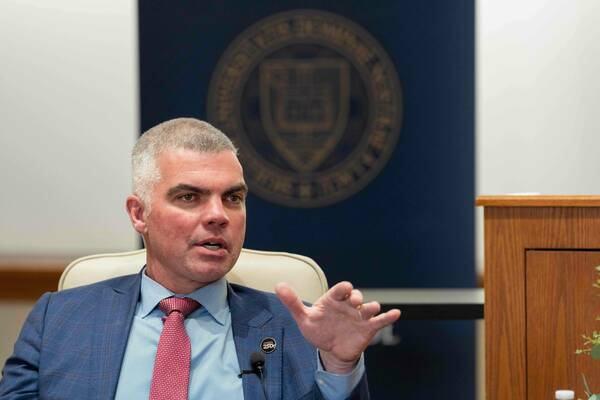
To open Death Penalty Abolition Week, Notre Dame Law School welcomed the Honorable Bob Morris, Indiana Representative, for a discussion moderated by Professor Jimmy Gurulé, founder and director of the Notre Dame Law School Exoneration Justice Clinic. Opening remarks were delivered by Dean G. Marcus Cole.
In his remarks, Dean Cole framed the conversation around human dignity and moral responsibility, emphasizing the Church’s teaching on capital punishment. He noted that the death penalty risks depriving the guilty of the possibility of redemption, adding, “Consequently, the Church teaches in the light of the Gospel that the death penalty is inadmissible.” His remarks set the tone for a discussion centered not only on law and policy, but also on faith, justice, and the value of human life.
Representative Morris spoke candidly about his legislative efforts to repeal the death penalty in Indiana, including his sponsorship of House Bill 1030. Grounded in his Catholic faith, Morris emphasized the principles of human dignity and the possibility of redemption, even for those who have committed the most serious crimes.
“Looking at the big picture, today we can house these people and feed them. We don’t have to kill them. How are they going to learn the difference between right and wrong?” he said, urging the audience to reconsider whether execution serves justice.
He also highlighted the transformative potential of redemption, asking, “If I told you that that prisoner brought one more person to Jesus Christ, would that change your mind?” He continued, “It sure should. They found Christ while they were in prison. The point is, if they bring one person to Christ, I think we should stop capital punishment in the state of Indiana because of that—because they found Christ and may go on to evangelize others.”
Morris also reflected on the bipartisan nature of his work, noting that efforts to abolish the death penalty have brought together unlikely allies across political lines. “Every single Democrat was voting with me on this—and I’m a pro-life legislator. It is but an interesting journey,” he said, pointing to a shared commitment to protecting life despite differing political perspectives.
Professor Gurulé closed the discussion by thanking Morris for his advocacy, stating, “Thank you for your strong leadership on this very important issue that has divided our country. I really do believe you are a profile in courage.”
Together, the discussion underscored how questions of justice, faith, and policy continue to shape the evolving conversation around capital punishment.
Erin Barnhart and Elwood Jones, federal public defender and Ohio death row exoneree, Defending the Innocent from Wrongful Execution

The second day of Death Penalty Abolition week included an emotional conversation with Notre Dame Law alumna Erin Barnhart ‘05 J.D., federal public defender, and her client Elwood Jones, an Ohio death row exoneree. Jones is an innocent man who spent nearly 30 years on death row after being falsely convicted of one count of aggravated murder, one count of aggravated burglary, and one count of aggravated robbery. Together, Jones and Barnhart shared the details of his typical workday at an Embassy Suites hotel which ended in his wrongful conviction and 30 years of imprisonment.
The talk included extensive details of the day of the murder, the botched police investigation that followed, and the trial which left Jones sentenced to a crime he did not commit. Barnhart explained the pivotal evidence and alternative suspects which were simply ignored by police and prosecutors as they narrowed in on Elwood from the beginning.
“The investigation showed incredible signs of tunnel vision and confirmation bias, and ignored really viable leads. They zeroed in on Elwood to the exclusion of anyone else. The state withheld nearly 4,000 pages of materials including investigative notes and witness statements which pointed to alternative suspects,” Barnhart explained.
Jones was finally exonerated after almost three decades on death row. Since his release in December 2022, he has devoted his life to others through constant volunteer work. Jones reflected on his life since his release, stating, “When I was in there, I lost a lot. I lost my parents, I lost my wife, and I lost two of my sisters. They took my life and turned it upside down. I had something before I got locked up. Now, I’ve got nothing. So, what do I do today? I volunteer in Cincinnati, I feed the homeless, I go to a school and read to little kids. On the side, I make teddy bears and gift them to anyone who has helped me.”
Jones and Barnhart’s conversation offered a powerful reminder of the human cost of wrongful convictions and the urgent need for accountability within the criminal justice system. Their story underscored both the devastating consequences of injustice and the resilience required to rebuild a life after it.
Anthony Ray Hinton, Enduring 30 Years on Death Row in Alabama

On Thursday, Anthony Ray Hinton, distinguished activist and author of the novel The Sun Does Shine, delivered his personal experience of 30 years on death row after a false conviction. At age 29, with no history of violent crime, Hinton was convicted of two counts of murder due to flawed evidence and a racist system in Alabama. He spent almost three decades on death row until he was finally exonerated and released on April 3, 2015.
During his talk, moderated by Professor Jennifer Mason McAward, Hinton shared the emotional details of his 30 years in solitary confinement in a 5×7 cell. He described the constant noise day and night, the 2:00 a.m. wakeups each morning, and the lack of decent food and sleep. Hinton also shared the relationships he formed with the others on death row, and how he even convinced the guards to allow him to start a book club amongst the inmates.
“I didn’t just spend 30 years on Alabama death row. I spent 30 years in pure Hell. It is so important for all of us to look at the death penalty in this country and do something about it,” he said.
Hinton also recalled that upon his arrest, the arresting officer told him that five specific, racially motivated factors would guarantee his conviction for a crime he did not commit. Dismissing Hinton’s innocence, the officer outlined the following reasons: (1) You’re Black, (2) A white man is going to say you shot him, (3) You’re going to have a white prosecutor, (4) You’re going to have a white judge, and (5) You’re going to have an all-white jury.
“I don’t care whether you did or didn’t do it,” Hinton recalled the officer telling him. “But I’m going to make sure you’re found guilty of it. There are five things they’re going to convict you on. Do you know what that spells? Conviction, conviction, conviction, conviction, conviction.”
The arresting officer’s statements underscored the racial discrimination deeply entrenched in the death penalty system.
Hinton urged Notre Dame Law School to consider his case as one of many wrongful convictions in which society cast him out and stopped treating him as a human being. He has spent the past 11 years since his exoneration devoted to sharing his personal story and strongly advocating for the abolition of the death penalty.
“I am hoping, I am praying, that some of you men and women become lawyers who can fight for those who cannot fight for themselves,” said Hinton. “I ask you to stand up and fight for me and the death penalty. I challenge every man and every woman here to do your research. Justice did not work. Had justice worked, I would not have been indicted in the first place. It was only a lawyer who cared enough to give me justice and freedom.”
Hinton’s testimony served as a powerful call to action, urging future lawyers to confront injustice and advocate for those whose voices have been silenced. His story reinforced the profound responsibility of the legal profession to pursue justice with integrity, compassion, and humanity.
Sarah Craft, Donna Schneweis, and Syl Schieber, A Call to Action
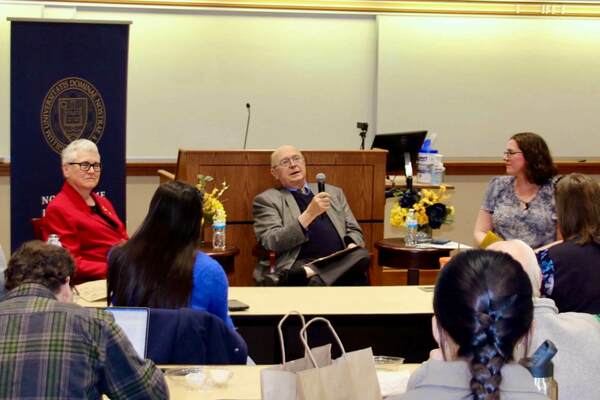
On the last day of Death Penalty Abolition Week, Syl Schieber moderated a discussion with Donna Schneweis, director of the Kansas Coalition Against the Death Penalty, and Sarah Craft, interim director of the Indiana Abolition Coalition.
Schieber opened the conversation by sharing the personal story that shaped his advocacy. After the murder of his daughter Shannon on May 7, 1998, he publicly opposed the use of the death penalty in her case, even as prosecutors chose to pursue it. Reflecting on that experience, he noted that victims’ families are not always heard when they oppose capital punishment, a realization that led him to turn grief into action.
“I began publicly organizing,” Schieber said, describing how his work grew into a national effort involving legislators, service organizations, and faith communities. He emphasized that meaningful change requires sustained, state-level engagement—“boots on the ground all over the country”—given that death penalty policy is often determined locally.
Craft then provided an overview of the current landscape in Indiana, describing a system shaped by executive authority and shifting political priorities. Although the state carried out no executions between 2009 and 2024, she explained that executions resumed in December 2024, with two more following soon after. “What we’re seeing is a rise in executions, not a rise in death sentences,” she said, underscoring renewed urgency for advocates. Craft also pointed to the risk of wrongful convictions, noting that Indiana has had two death row exonerations, and highlighted the high costs of lethal injection protocols.
She described emerging bipartisan dynamics, including alliances with legislators such as Representative Bob Morris, and framed Indiana as a “microcosm of what’s going on around the country.” For Craft, the path forward lies in what she called “abolition by attrition”—gradually narrowing the use of the death penalty until it can no longer be sustained.
Schneweis offered a parallel perspective from Kansas, where the death penalty remains legal but rarely used. She traced the state’s complex history, noting that Kansas has carried out relatively few executions in its history, with none since 1965, and has not seen a capital conviction since 2015. Despite high-profile cases that can intensify public support for capital punishment, she emphasized the strength of a growing bipartisan coalition working toward repeal. “Republicans are willing to support repeal,” she said, pointing to legislative efforts such as House Bill 2272 and Senate Bill 245 as evidence of cross-party momentum.
Schneweis also highlighted the coalition’s dual strategy of pursuing repeal while defending against efforts to expand execution methods, including proposals like nitrogen gas. Bringing together religious advocates and fiscal conservatives, she noted, has been key to advancing the conversation in a politically diverse state.
Together, these conversations offered a profound reflection on the moral, legal, and human dimensions of the death penalty, challenging the Notre Dame Law School community to engage more deeply with issues of justice, dignity, and accountability. Through the voices of those directly impacted and those actively working toward reform, Death Penalty Abolition Week reaffirmed the importance of advocacy, compassion, and a steadfast commitment to protecting human life.
Learn more about the Notre Dame Law School Exoneration Justice Clinic at exoneration.nd.edu, the Klau Institute for Civil and Human Rights at klau.nd.edu, and the Institute for Social Concerns at socialconcerns.nd.edu.
Originally published by at law.nd.edu on April 06, 2026.