Exonerations
Since its founding in late 2020, the Notre Dame Exoneration Justice Clinic (“NDEJC”) has exonerated five people: Andrew Royer, Anthony Bedolla, Kara Beaty, Reggie Dillard, and Iris Seabolt.
Andrew Royer

In 2005, Andrew Royer was wrongfully convicted of the November 2002 murder of 94-year-old Helen Sailor in Elkhart, Indiana. He was sentenced to 55 years in prison.
At Royer’s 2005 joint trial with his co-defendant, Lana Canen, the State relied on three key pieces of evidence. First, the State relied on testimony from an Elkhart County sheriff’s deputy, who testified that a latent fingerprint found in Ms. Sailor’s apartment was a “match” to Ms. Canen. Second, the State relied on testimony from an Elkhart Police Department detective who obtained a supposed confession from Mr. Royer—a mentally disabled man—after interrogating him for two days. Third, the State relied on the testimony of Nina Porter, a witness who claimed that Ms. Canen had made comments suggesting she was involved in Sailor’s murder.
In 2012, new evidence proved that the sheriff deputy’s identification of Canen’s fingerprint was false. The deputy admitted in a deposition that his identification was wrong. In fact, he had identified the wrong finger, on the wrong hand, on the wrong person. The deputy further admitted that, at the time he conducted his analysis, he was not even qualified to conduct latent print comparisons. Based on this evidence, Canen’s conviction was vacated. But for nearly another decade, the Elkhart County Prosecutor’s Office left Mr. Royer’s conviction—which was based on this same evidence—intact. Mr. Royer remained in prison.
In June 2019, the NDEJC filed a successive petition for post-conviction relief in Elkhart court on Mr. Royer’s behalf. Judge Joe V. Sutton of Kosciusko Superior Court No. 3 was appointed as special judge in the case. Judge Sutton held an evidentiary hearing on the petition in Fall 2019.
In March 2020, Judge Sutton entered a 55-page order vacating Mr. Royer’s conviction on numerous independent grounds. In this order, Judge Sutton found that the State withheld exculpatory evidence from Mr. Royer and fabricated false evidence against him. Judge Sutton found that the interrogating detective had fed Mr. Royer information about the crime and exploited his mental disability to obtain an involuntary confession from him. Judge Sutton further found that this detective lied under oath to Mr. Royer’s jury when he testified that he did not provide any details about the crime to Mr. Royer. In addition, Judge Sutton found that the detective had coerced Nina Porter into giving a false statement and that the State had withheld that it paid Nina Porter $2,000 in exchange for her testimony in the case. On April 2, 2020, Judge Sutton released Mr. Royer from prison on his own recognizance after 17 years of wrongful incarceration.
On April 8, 2021, the Indiana Court of Appeals affirmed Judge Sutton’s grant of a new trial and found that the State repeatedly violated Mr. Royer’s constitutional rights by withholding favorable evidence from him. See State v. Royer, 166 N.E.3d 380 (Ind. Ct. App. 2021). In a strongly-worded opinion, the Court of Appeals found that the Elkhart detective committed perjury during Mr. Royer’s 2004 criminal trial when he denied providing Mr. Royer with information about the crime. The Court of Appeals found that this was “particularly galling” because the officer was an EPD detective at the time of Mr. Royer’s trial and post-conviction proceedings. The Court explained that, “when law enforcement officers lie under oath, they ignore their publicly funded training, betray their oath of office, and signal to the public at large that perjury is something not to be taken seriously. This type of conduct diminishes the public trust in law enforcement and is beneath the standard of conduct to be expected of any law enforcement officer.” Id. at 404 n.20.
On July 19, 2021, the charges against Mr. Royer were finally dismissed, and Mr. Royer was officially exonerated. Mr. Royer’s exoneration was the product of a collaborative effort between the NDEJC, the Wrongful Conviction Clinic at IU McKinney Law School, and the Exoneration Project at the University of Chicago.
You can learn more about Andrew Royer’s case here.
Anthony Bedolla

In 2010, Anthony Bedolla was wrongfully convicted of the March 2009 murder of Erick Espinoza in Indianapolis, Indiana. He was sentenced to 45 years in prison.
In 2022, the NDEJC took on Mr. Bedolla’s case. Through a joint investigation with the Conviction Integrity Unit (“CIU”) of the Marion County Prosecutor’s Office, the NDEJC uncovered new evidence showing that Mr. Bedolla was not the man who killed Mr. Espinoza. The NDEJC also uncovered evidence that the Indianapolis Metropolitan Police Department had withheld exculpatory evidence pointing to Mr. Espinoza’s true killer and evidence that would have seriously undermined the credibility of the State’s key witness in the case.
On August 13, 2024, the NDEJC filed an amended petition for post-conviction relief raising claims based on this new evidence. In response, the Marion County CIU agreed that Mr. Bedolla was entitled to a new trial and stated that the State no longer had confidence in the integrity of Mr. Bedolla’s conviction. On August 20, 2024, Marion County Judge Marie Kern vacated Mr. Bedolla’s convictions and dismissed the charges against him. Shortly thereafter, Mr. Bedolla was released from jail after serving over 14 years in prison for a crime he did not commit.
You can learn more about Mr. Bedolla’s case here.
Kara Beaty
In 2023, Kara Beaty was wrongfully convicted of causing death or catastrophic injury while operating a vehicle with a controlled substance in her blood. This charge stemmed from a June 2020 collision between Ms. Beaty’s vehicle and a motorcyclist. Ms. Beaty was only 18 years old at the time of the crash.
At Ms. Beaty’s August 2023 trial, the key issue was whether Beaty in fact caused the collision with the motorcyclist. The State’s case relied on two key pieces of evidence. First, a purported eyewitness testified that he was traveling behind the motorcyclist at the time of the collision and that the motorcyclist was traveling roughly 30 miles per hour. Second, a member of the St. Joseph County Fatal Alcohol and Crash Team testified that he determined, based on the distance that the motorcyclist's body was thrown after the crash, that the motorcyclist’s speed was 37-42 miles per hour at the time of the crash. Beaty was convicted based on this evidence and was sentenced to six years in prison, with three years executed at the Indiana Department of Corrections and three years on probation. On October 10, 2023, Ms. Beaty was sent to Indiana prison.
But evidence that was never heard by Beaty’s jury proved the State’s theory of the case to be wrong. The motorcyclist had in fact broadcasted his motorcycle ride leading up to the crash on “Facebook Live.” Landmarks visible in this Facebook Live video showed the motorcyclist’s actual route of travel, which contradicted the testimony of the purported eyewitness. In addition, an analysis of landmarks visible in the Facebook Live video showed that the motorcyclist was traveling over 100 miles per hour in the seconds before the crash—nearly three times as fast as the trial evidence suggested.
In October 2024, the NDEJC took on Ms. Beaty’s case. The NDEJC worked together with South Bend attorney John Kindley on the case. On March 28, 2025, the NDEJC and St. Joseph County Prosecutor’s Office filed a joint motion asking that Ms. Beaty’s conviction be vacated. On April 15, 2025, Judge Jeffrey Sanford of St. Joseph Superior Court No. 3 granted Ms. Beaty’s petition for post-conviction relief and vacated her conviction.
You can learn more about Ms. Beaty’s case here.
Reginald Dillard
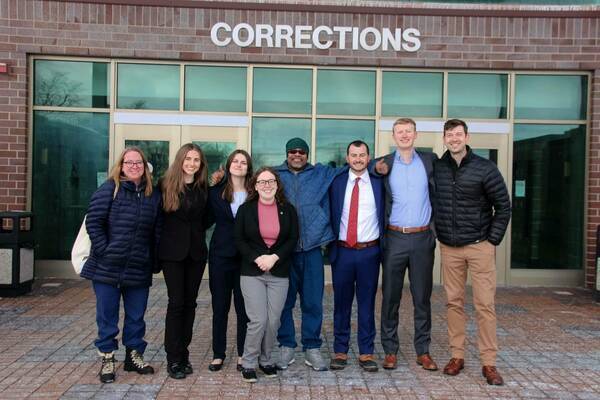
Reginald Dillard was wrongfully convicted of the 1998 murder of Christopher Thomas in Elkhart, Indiana and sentenced to 65 years in prison. At Mr. Dillard’s January 2000 trial, the State presented no physical evidence linking him to the murder. Instead, the State’s case rested on the testimony of jailhouse informants and a prostitute who had been developed as a witness by Elkhart Police Department (“EPD”) Detective Stephen Rezutko.
The NDEJC filed a petition for post-conviction relief on Mr. Dillard's behalf in July 2022. In that petition, Mr. Dillard alleged that he was innocent of Thomas’s murder and that the State had violated his constitutional rights under Brady v. Maryland, 373 U.S. 83 (1963) by withholding material exculpatory and impeachment evidence. Mr. Dillard alleged that the State withheld (among other things): (1) a police report from the day after Mr. Dillard was convicted providing detailed and compelling evidence implicating two other men in Thomas’s murder; (2) EPD internal affairs files showing that Detective Rezutko had been disciplined and then forced to resign from the EPC because he had engaged in improper sexual acts with female informants, including a female informant against Mr. Dillard; and (3) evidence that the jailhouse informants who testified against Mr. Dillard had been promised consideration in exchange for their testimony.
After Dillard’s petition was filed, the Elkhart County Prosecutor’s Office was disqualified from the case due to a conflict of interest. Nelson Chipman, the elected prosecutor of Marshall County, Indiana, was appointed as a Special Prosecutor. The case proceeded to an evidentiary hearing before Elkhart County Judge Christopher Spataro in February 2026. At the close of the evidence, Mr. Chipman agreed that the evidence showed that Mr. Dillard’s due process rights under Brady had been violated and that his conviction should be vacated. Judge Spataro entered an order vacating Mr. Dillard’s conviction.
A few days later, on February 23, 2026, the State’s motion to dismiss the criminal charges against Mr. Dillard was granted, and Mr. Dillard was officially exonerated. Mr. Dillard was released from the Elkhart County Correctional Complex that same day—a free man for the first time in over 27 years.
You can read more about Mr. Dillard’s case here.
Iris Seabolt
